
YSM20R vs YSM10 : which speed class fits your line
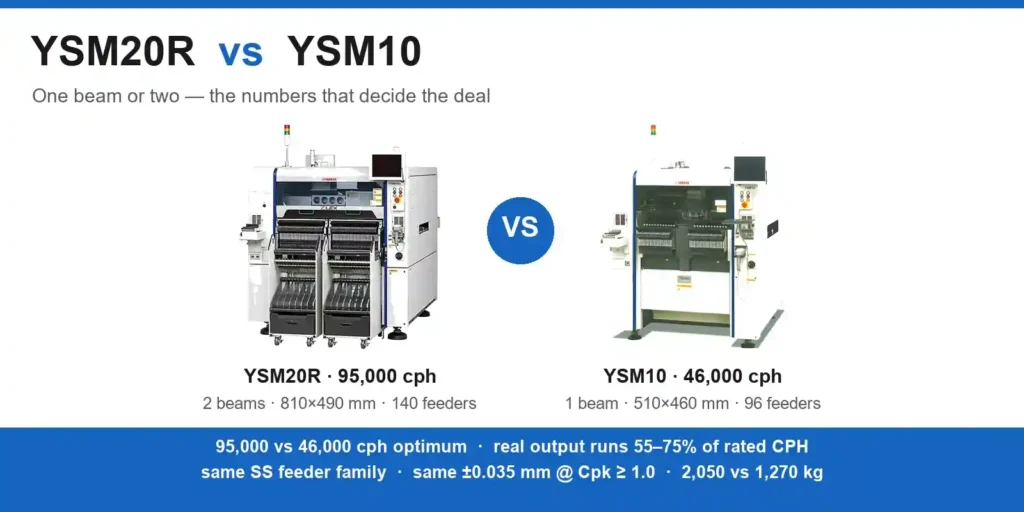
One beam or two — that is the whole question. Both are Yamaha YSM-series mounters, sharing the same feeder family, the same 3-phase power spec and the same ±0.035 mm accuracy claim. The difference is structural, and it sets your throughput ceiling, your board-size limit and how many unique parts you can keep loaded. Which is exactly why it is the first thing to get right when you buy used.
| Item | YSM10 | YSM20R |
|---|---|---|
| Structure | 1 beam, 1 head | 2 beams, 2 HM heads (1-head solution) |
| Placement speed | 46,000 CPH (10-nozzle HM) / 31,000 CPH (5-nozzle HM5) | 95,000 CPH (2-beam, HM × 2); 90,000 and 81,000 in other configurations |
| Accuracy | ±0.035 mm (±0.025 mm), Cpk ≥ 1.0 | ±0.035 mm (±0.025 mm), Cpk ≥ 1.0 |
| Component range | 03015 to 55 × 100 mm, height ≤ 15 mm | 0201 (dedicated nozzle) to 55 × 100 mm, height ≤ 15 mm; FM head to 28 mm |
| PCB size | 510 × 460 mm down to 50 × 50 mm (950 mm length optional) | Single lane 810 × 490 mm; dual lane up to 810 × 355 mm same-type, 810 × 662 mm mixed |
| Feeder positions | 96 × 8 mm fixed plate; 15 tray types | 140 × 8 mm fixed plate or 128 carriage; 30 tray types |
| Footprint | 1,254 × 1,440 × 1,445 mm | 1,374 × 1,857 × 1,445 mm |
| Weight | Approx. 1,270 kg | Approx. 2,050 kg |
| Power / air | 3-phase 200–416 V, 0.45 MPa | 3-phase 200–416 V, 0.45 MPa |
Everything in that table comes from Yamaha’s own catalogue figures, measured under the company’s optimum conditions. If you want the full sheet rather than the summary, plus the machines we currently have on the floor, see YSM20R specifications and current price — we keep it tied to the actual units in stock, not a brochure.
Speed: 95,000 vs 46,000 is not the whole story
The headline ratio is roughly two to one. In practice the gap opens wider than the numbers suggest, because the advantage is architectural rather than incremental.
YSM10 is a single-beam machine: one head crosses the board, picks, places, returns. Its 46,000 CPH comes from a 10-nozzle HM head working that single gantry flat out. The 31,000 CPH figure is the same machine fitted with a 5-nozzle HM5 head — a configuration buyers chose for larger parts and gentler handling, at the cost of a third of the speed.
YSM20R puts two HM heads on two beams. They work the same board in parallel, splitting the field in half. That is why its rated 95,000 CPH is not just “faster nozzles” — it is two full placement engines sharing one conveyor.
Two caveats worth knowing before you count on either number:
- CPH is an optimum-condition figure. Real output on a mixed BOM typically lands at 55–75% of rated CPH once you account for feeder index time, vision rejects, and board transfer. A line that quotes 95,000 usually runs 60,000–70,000 in production.
- Speed only pays on chip-heavy work. If your board is 80% 0402 and 0603 passives, the two-beam architecture earns its price every shift. If your board is 300 placements of which 40 are connectors and shields, the second beam spends much of its time waiting on the FM head — and you have paid for capacity you cannot use.
Board size decides more deals than speed
This is the specification that quietly kills more purchase plans than any other, and it is the one buyers check last.
YSM10 tops out at 510 × 460 mm. There is an option that extends usable length to 950 mm, but that is a special order, not a standard machine on the used market.
YSM20R handles 810 × 490 mm on a single lane — 59% more length and 6% more width. In dual-lane mode it splits into two independent flows: same-type boards up to 810 × 355 mm each, or two different boards with the 2-beam option giving up to 810 × 662 mm combined.
What that means in real terms:
- LED lighting strips, long automotive boards, power supply modules — if any product in your pipeline exceeds half a metre in length, YSM10 is out before the conversation starts.
- Two-product lines — dual lane lets you run an A product and a B product simultaneously instead of batching. On a line that changes over three times a day, that is worth more than the CPH difference.
Feeder positions: the high-mix trap
YSM10 holds 96 × 8 mm feeder positions. YSM20R holds 140 on a fixed plate, or 128 with a carriage, plus 30 tray types against YSM10’s 15.
Run the arithmetic on your own BOM before you buy. If your board carries 110 unique 8 mm parts, YSM10 cannot hold the job in one setup — you will be splicing, swapping carts, and eating changeover time on every run. That is not a small inconvenience; it is the difference between a line that runs unattended overnight and one that needs an operator standing next to it.
YSM20R’s 140 positions and 30 trays are what make it viable for high-mix, low-volume work — the exact profile most contract manufacturers in Europe and North America now live on. It is also why the machine has held its resale value better than the entry-level model.
The 28 mm head: odd-form parts
YSM10’s ceiling is 15 mm component height, and above 6.5 mm height or 12 mm body size you need the optional multi-camera. It is a chip machine with a competent range, not an odd-form machine.
YSM20R ships with the same 15 mm HM head limit but accepts an FM (Flexible Multi) head rated to 28 mm. That covers transformers, tall electrolytics, shielded connectors, and the kind of parts that otherwise force you to keep a separate pick-and-place or a manual station in the line.
It also carries Yamaha’s 1-head solution: the HM head handles both 0201 micro-chips and 55 × 100 mm large components without a head swap. On older platforms, switching between chip and odd-form work meant stopping the line to change heads. Removing that step is worth roughly an hour per changeover on a high-mix schedule.
Floor, power and rigging
Both machines run the same 3-phase 200–416 V supply and the same 0.45 MPa clean dry air requirement, so the electrical work is a wash. The physical side is not.
YSM10 weighs about 1,270 kg; YSM20R about 2,050 kg, and the wide-body YSM20WR variant goes to roughly 2,500 kg on a 2,110 mm width. On a ground-floor slab that difference is academic. On an upper floor, in a leased building, or behind a freight elevator with a 1,500 kg limit, it decides whether the machine can be installed at all.
Check three things before signing: the slab load rating, the door and corridor width on the route in, and the crane or forklift access at the loading dock. A 2,050 kg machine that cannot physically reach your production floor is a 2,050 kg problem.
What to check on a used unit
The used market for both models is deep, and condition varies more than the model number suggests. Four checks carry most of the risk:
- Running hours and beam wear. Two-beam machines accumulate hours on both gantries; ask for the hour meter per beam, not a total.
- Feeder bank authenticity. On a YSM20R the feeders often represent half the invoice value. Count them, grade them, and confirm they are the SS-family units the machine expects — not third-party substitutes.
- Head vacuum and nozzle condition. Pull the nozzle set, check for clogged tips and worn vacuum pads. A full nozzle set is a four-figure line item.
- Axis accuracy verification, not just power-on. Ask for a placement accuracy run with results, not a photo of the machine switched on.
Yamaha now lists YSM10 as a discontinued product on its global site, which means the used channel is the only channel. That is not a reason to avoid it — it is a reason to buy from a seller who can document condition, because there is no factory-new fallback if you get it wrong.
How to choose
Three rules that settle most of these decisions:
Choose YSM10 if your boards are under 510 × 460 mm, your BOM fits inside 96 feeder positions, nothing on the board is taller than 15 mm, and you need a compact machine on a modest floor. It is the right answer for a single-product line running steady volume, and it costs meaningfully less per placement.
Choose YSM20R if any one of these is true: boards longer than 510 mm, more than ~96 unique 8 mm parts, components taller than 15 mm, two-product parallel running, or a mix that changes over more than twice a day. Any single one of those conditions makes the entry model the wrong tool, regardless of price.
Choose neither if your real bottleneck is not placement speed. A line fed by a slow printer or a manual loader will not get faster because the mounter can do 95,000 CPH — it will just idle faster.