
TRI AI Verify Host: One AI Brain for the Whole Factory
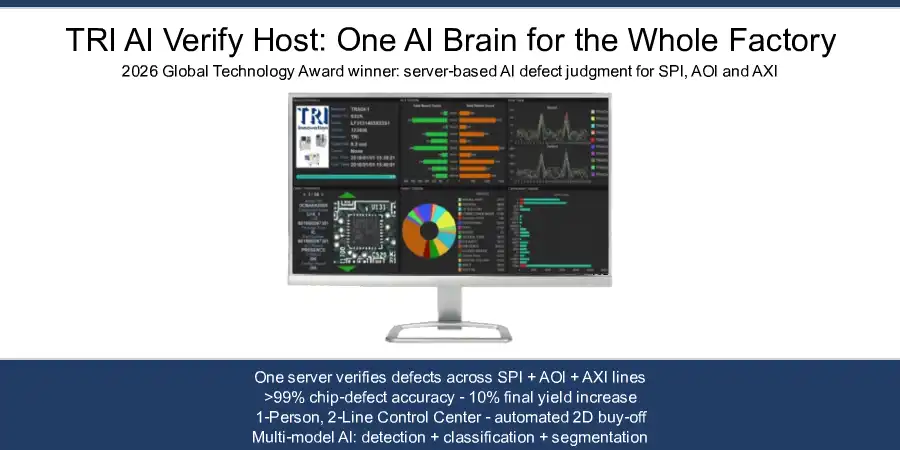
TRI AI Verify Host: One AI Brain for the Whole Factory
Innovation angle — the judgment layer, not another camera
Every SMT factory has a quiet bottleneck that no spec sheet advertises: the repair station. SPI, AOI and AXI keep getting faster and sharper, so they flag more images than ever — and every one of those images still ends up in front of a human operator. Thousands of review decisions per shift, most of them false calls caused by conservative inspection windows that engineers widen precisely because they are afraid of escapes. Adding inspection machines multiplies the problem instead of solving it.
That is why the most interesting inspection innovation of this season is not a new sensor at all. On October 28, 2026, Test Research, Inc. (TRI) announced that its AI Verify Host — an AI-powered repair station — received a 2026 Global Technology Award in the Software Process Control category, presented during SMTA International week in Rosemont. What won the award was not optics. It was an architecture decision: move defect judgment off each individual machine and into one shared server brain.
What AI Verify Host actually is
TRI AI Verify Host is a centralized, server-based AI repair station that automates defect verification across SPI, AOI and AXI systems. Instead of relying on operators to review thousands of inspection images each shift, the platform uses multi-model AI — detection, classification and segmentation — to deliver automated defect judgment.
The flow is deliberately simple. Inspection lines flag defects as they always have. The repair stations forward the defect data to the AI Verify Host server. The server returns a pass/fail judgment back to the line. One AI Verify Host server can connect to and service multiple inspection lines at once — AOI, SPI and AXI together — which TRI describes as centralizing the factory’s AI power in a single place.
Why the architecture is the innovation
1. Judgment becomes shared infrastructure. In a conventional line, every inspection machine owns its own decision logic and its own review queue. AI Verify Host inverts that: the decision layer lives on one server that every machine feeds into. When the AI improves, every line it serves improves at the same moment. Adding a new AOI no longer means adding a proportional amount of review labor.
2. Automated buy-off closes the loop. A key application is verifying all 2D inspection windows — the conservative, hand-tuned windows that generate most false calls — and automating the buy-off process. The AI re-judges what the rule-based machine hesitated on, which is exactly where the wasted operator hours live.
3. The AI audits itself. The system includes intelligent SPC reporting that tracks and compares AI results against operator judgments. That turns accuracy from a marketing claim into a monitored process variable you can trend, challenge and improve.
4. The numbers are production-proven, not lab numbers. In real-world applications TRI reports accuracy above 99% for common chip defects such as missing, shifted and tombstoned parts, and a 10% increase in final yield rate. The official case studies describe a “1-Person, 2-Line Control Center” that reduced operators needed per line, with 99.5% AI accuracy in that configuration and over 80% overall accuracy reached after just three months of AI training.
It sits inside a bigger bet
AI Verify Host is one layer of TRI’s wider AI ecosystem: AI Smart Programming cuts AOI setup from hours to minutes, AI Fine Tuning tunes AXI parameters without expert retraining, the AI Training Tool generates and customizes models, AI Station deploys AI inference to multiple lines, and AI DLOCR handles characters rule-based OCR cannot read. TRI also develops AI in-house alongside partnerships with NVIDIA (integrating the Metropolis for factories workflow into its portfolio) and a joint AI visual inspection project with Bosch for MEMS packaging. The repair-station award is the visible tip of a full-stack strategy.
Buyer’s checklist — five questions before you sign
- Line coverage: which generations of my existing SPI, AOI and AXI can connect to the AI Verify Host server, and does verification cover 2D windows only or 3D results as well?
- IT reality: what does “1-Person, 2-Line” actually require — network bandwidth for image transfer, storage, MES integration, and who owns that integration?
- Training window: how many boards or months before AI accuracy stabilizes on my product mix — and who validates the three-month training curve on the official page against my own boards?
- Accountability: when AI passes a board that escapes, what does the SPC audit trail show, and can I replay the AI’s judgment versus the operator’s?
- Economics: is licensing priced per server, per line or per image — and does the math still work when I add lines four and five?
The takeaway
Inspection cameras will keep getting better, and the megapixel race is not over. But this award went to judgment, not to a camera. For factories running several inspection machines across several lines, the cheapest capacity gain of the next upgrade cycle may not be another AOI — it is making the machines you already own agree with each other, and letting one AI brain do the agreeing.