
BTU Pyramax 150A Skills: The Profiling Skills Behind Boards That Fly on Satellites
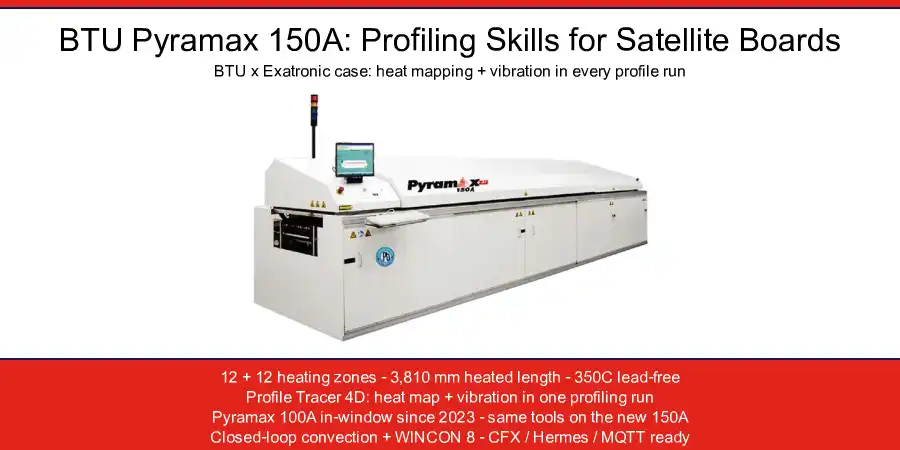
BTU Pyramax 150A Skills: The Profiling Skills Behind Boards That Fly on Satellites “Reflow is where reliability is won or lost,” says Nuno Gomes, CEO of Portuguese electronics manufacturer Exatronic. “Some of our boards now fly on satellites, and nobody can repair them once they are launched.”
That quote comes from a case study BTU International published in October 2026, and it is worth reading twice — not because the oven is exotic, but because the story is about skills. Exatronic runs a BTU Pyramax 100A eight-zone oven that has stayed inside its process window since 2023, and in 2026 it added a Pyramax 150A twelve-zone oven with the same process-control toolkit. Two ovens, one philosophy, and a set of profiling habits that any factory can copy.
Here is what that discipline actually looks like.
BTU Pyramax 150A Skills The machine, in plain numbers
The Pyramax 150A z12 is BTU’s largest air-atmosphere convection reflow platform:
- Heated length: 3,810 mm (150 in) with 12 top + 12 bottom independently controlled heating zones
- Cooling: 1,219 mm with 2 top + 2 bottom cooling zones
- Conveyor: 51–457 mm (2–18 in) width, 25–152 cm/min speed, programmable heating and cooling rates
- Max process temperature: 350°C, guaranteed for lead-free
- System footprint: 6,474 × 1,524 mm, 1,524 mm high, 208–480 VAC
- Control: BTU’s WINCON 8 — SmartPower management, Energy Pilot, RecipePro, and Industry 4.0 connectivity via CFX, Hermes, OPC, REST and MQTT
Standard features include forced convection with side-to-side gas recirculation, dynamic gas idle, SMEMA product tracking, electronic over-temperature protection, and an optional closed-loop convection control. The Aqua Scrub flux management system continuously removes flux contaminants from the oven atmosphere with water, so performance stays consistent regardless of flux type. BTU backs the platform with a lifetime warranty on heaters and blowers, three years on system components, and one year on labor.
Impressive specs — but the oven is only half the story.
BTU Pyramax 150A Skill 1: Profile the board, not the brochure
Every reflow engineer profiles boards. Not every engineer profiles well. The baseline skill is attaching thermocouples to the actual thermal mass of the product — a BGA ball, a heavy connector pin, the board’s thickest copper region — and judging the profile by what the solder sees: ramp rate, soak, time above liquidus (TAL), peak, and cooling slope. BTU’s programmable heating and cooling rates give you the authority to set these targets; the profiling skill is verifying them on your board, in your line, every time a product changes.
The 150A’s twelve zones exist for a reason: more zones means finer segmentation of the ramp and soak regions, which is how you hold one profile for dense, high-mass assemblies without cooking the light ones. But zone count doesn’t do the work. The thermocouple placement does.
Skill 2: Profile the oven, not just the board
This is where the Exatronic case gets interesting. The facility pairs its Pyramax ovens with Profile Tracer 4D, a process-optimisation solution engineered by iRaptor that extends conventional profiling with two extra data layers collected during the same routine run:
- Pyrometer heat mapping — a full temperature-distribution map across the oven’s working width, verifying that the left edge and the right edge of the conveyor actually see the same process. Width-wise variation is the classic silent killer of reflow repeatability; a single centerline thermocouple never sees it.
- Vibration analysis — mechanical condition monitoring of the conveyor and blower assembly, captured automatically. A bearing that is starting to fade shows up as a vibration signature weeks before it shifts your thermal behavior or marks a board.
“Profile Tracer 4D tells us how the oven itself is behaving, every time we profile a board,” Gomes says. In other words: the profile run doubles as an oven health check, with no separate measurement procedure and no extra downtime.
Skill 3: Define the window, then defend it with data
The deepest habit in the Exatronic story is that the team established acceptable operating parameters — an explicit process window for thermal behavior and vibration — and then monitors every profile against those known limits. Deviations trigger corrective action; drift doesn’t get to accumulate quietly.
The proof is cumulative: the Pyramax 100A has stayed inside its process window since 2023. That is three years of aerospace-grade consistency, measured, not assumed. When Exatronic added the 150A in 2026 for more demanding sectors, the decision was almost administrative: “Adding the 150A with the same tools was an easy decision. It means our aerospace, and other high reliability electronics customers get the same result, batch after batch.”
Skill 4: One recipe of practice across ovens
Factories that scale reflow capacity often discover that their second oven behaves like a foreign country — different software, different profiling tools, different habits. Exatronic avoided that by applying the same process-control philosophy to the new twelve-zone machine from day one: same profiling routine, same heat-mapping and vibration limits, same documentation. The result is a single thermal skill set that transfers between an 8-zone and a 12-zone oven, which is exactly what you want when high-reliability work moves between lines.
Skill 5: Let the data travel
A profile that lives in a spreadsheet on one engineer’s laptop is not a process. BTU’s WINCON 8 control system ships with CFX, Hermes, OPC, REST and MQTT connectivity, so thermal data, recipes and traceability can flow into MES without proprietary middleware. Combined with automatic flux management and smart idle modes, the oven becomes a node in the factory’s data spine — and the profiling skill becomes institutional memory instead of tribal knowledge.
A 30-day ramp for your line
- Week 1 — Re-profile every active product; document ramp, soak, TAL, peak and cooling for each, with thermocouple placement photos.
- Week 2 — Run a full-width heat map of the oven; record the worst delta across the working width and set a warning limit.
- Week 3 — Baseline vibration (or equivalent machine-condition data) against a healthy oven; define “acceptable” in writing.
- Week 4 — Wire profiling results into your SPC/MES workflow, and make “profile against limits” part of every NPI checklist.
Where the 150A is not the answer
Honesty keeps skills sharp. If your bottleneck is solder voiding under power devices or SiP packages, the machine you want is the Pyramax Vacuum variant — the 150A is an air convection oven, and nitrogen capability belongs to the 150N z12. If you are running extremely heavy AI-server boards, BTU positions its Aurora platform with extended-length and heavy-load configurations for exactly that market. Match the platform to the failure mode you actually have.
The takeaway
An oven is the easiest machine on the line to buy and the hardest to master. What the BTU–Exatronic case demonstrates is that the differentiator isn’t twelve zones or 3,810 mm of heated length — it’s the discipline of profiling the board and the oven, writing down the window, and defending it with data for years. Do that, and your boards will survive wherever they fly.