
ASMPT Keeps SMT: What the Decision Means for SIPLACE Buyers
ASMPT Keeps SMT: What the Decision Means for SIPLACE Buyers
For the past ten months, buying a SIPLACE machine meant buying into an unanswered question.
On January 21, 2026, ASMPT announced a formal assessment of strategic options for its SMT Solutions segment — the division that builds SIPLACE placement platforms, DEK printers, and the WORKS software suite. The options on the table were serious: divestiture, joint venture, spin-off, public listing, or keeping the business inside the group.
Every procurement manager, every service contract holder, and every dealer in the second-hand market read that press release the same way: who will own the machines I am buying, the spare parts I am stocking, and the software licenses I am paying for?
On November 5, 2026, the question was answered. ASMPT’s Board concluded that retaining the SMT Solutions segment within the group is in the best interests of the company and its shareholders. The assessment is closed. No sale, no spin-off, no listing.
The announcement is not a new machine, a new head, or a new factory. But for anyone whose money touches SIPLACE equipment, it may be the most consequential SMT decision of 2026. Here is the practical reading.
What the Decision Means for SIPLACE Buyers,The Numbers Behind the Decision
ASMPT did not keep SMT out of sentiment. The figures published with the decision explain the logic:
- Bookings market share: up from around 24% in 2025 to approximately 31% in 2026 year-to-date.
- Bookings value: more than doubled, from around US
0.7 billion to above US1.4 billion for the same period.
- AI-related bookings: grew from 12% of bookings in 2024 year-to-date to more than 50% in 2026 year-to-date — a roughly fourfold increase in two years.
- Advanced Packaging: bookings of approximately US$340 million year-to-date, about 25% of segment bookings.
- Market outlook: ASMPT estimates the SMT addressable market will expand at a compound annual growth rate of more than 20% from 2024 to 2027.
- Financial trajectory: segment revenue projected to double from the 2025 level to approximately US$1.6 billion by 2027, with gross margin rising from the low-30% range to about 40% and segment profit margin reaching 20% by 2027.
Group CEO Bassel Haddad, who joined in August, framed it as clarity: “With this clarity on SMT’s future within ASMPT, we are focused on disciplined execution to realise this potential.”
Clarity is exactly what buyers were missing. Now they have it — and it changes what you should do next.
What Changes in Practice
1. The pause can end. If your team deferred a platform decision this year while waiting to see who would own ASMPT’s SMT business, the deferral reason is gone. Service contracts, WORKS software licenses, training programs, and spare-parts supply all continue under the same legal entity, within the same HKEX-listed group. Nothing needs to be renegotiated around an ownership transfer.
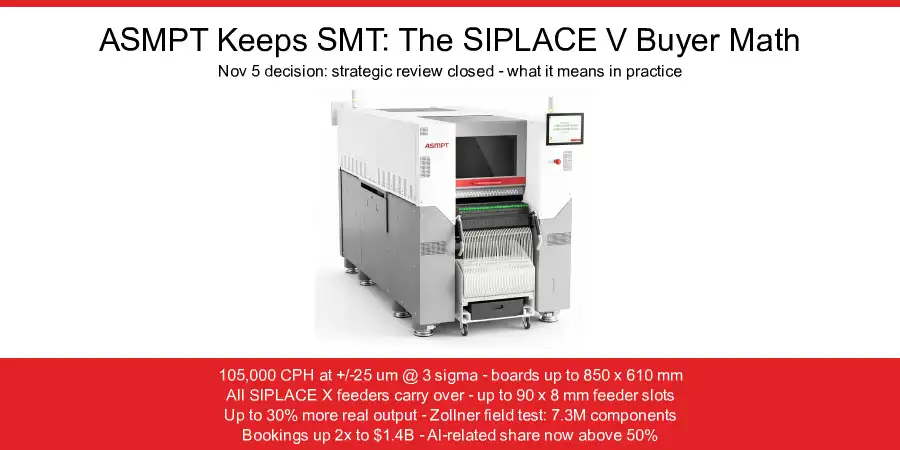
2. Your feeders carry over. This is the part most buyers underestimate. The SIPLACE V platform — launched January 2026 — supports all SIPLACE X feeders, along with linear dipping units, power connectors, glue feeders, and measuring feeders. A factory running an X-series or X4i line does not throw away its feeder fleet to move to the new platform. The V offers up to 90 x 8 mm feeder slots, and its universal head interface allows heads to be swapped during operation. In equipment-buying math, a platform that preserves your consumables and tooling estate is worth real money.
3. The machine math is real. The SIPLACE V runs at 105,000 cph with ±25 µm @ 3σ standard accuracy, handles boards up to 850 x 610 mm in single-lane mode (400 x 280 mm in dual-lane, or 700 x 530 mm “dual as single”), and does it from a 1.1 x 2.4 m footprint. The V L variant takes component heights up to 55 mm from a 1.5 x 2.4 m footprint. ASMPT claims up to 30% more real production output, and the claim is backed by a named field test: Zollner Elektronik ran roughly 25,000 modules and 7.3 million components through the platform in high-mix, low-volume production and confirmed the result.
4. The second-hand market just got a signal. This is the note dealers and used-equipment buyers should read twice. With more than half of new bookings now AI-related, new SIPLACE capacity is flowing to AI server and networking lines. That flow accelerates the refresh of older SIPLACE X and X4i fleets into the used market — and because the new platform accepts SIPLACE X feeders, the feeders and nozzles that come with those machines stay liquid. A used X-series feeder stock is not orphaned inventory; it is compatible stock for both old and new lines.
5. What did not change — and what to watch. The decision locks strategy, not market conditions. The doubling to US$1.6 billion revenue by 2027 is a projection, and AI-driven demand is doing most of the lifting. If AI infrastructure investment softens, the segment’s financial profile softens with it. The ownership question is settled; the demand question never fully is.
Five Questions to Ask Before Signing
- Compatibility in writing: confirm with ASMPT which heads, nozzles, and feeders from your current fleet are certified for the V or V L variant you are quoting — especially if your board mix needs the 55 mm component height.
- Real-condition throughput: the “up to 30%” gain is field-condition based. Ask for a benchmark run on your own product mix, not a catalogue figure.
- Service and spares lead times: get current regional lead times and pricing confirmed post-decision, so your maintenance planning rests on today’s numbers.
- Used X-series as feeder donors: if you are buying used SIPLACE X machines to feed a V line, verify feeder generation and firmware compatibility before the deal, not after.
- Delivery queue position: with AI-related bookings above 50%, ask how standard configurations are sequenced against large AI-server orders — delivery timing is now part of the price.
The Takeaway
For ten months, SIPLACE purchases carried a question mark that had nothing to do with the machines themselves. That question mark is gone. What remains is the platform math: 105,000 cph at ±25 µm, boards to 850 x 610 mm, feeders that carry over from your existing line, and a parent company that just decided its SMT business is worth keeping.
For buyers, dealers, and service teams alike, that is the most practical kind of news — the kind that lets you sign the next purchase order without an asterisk.