
ASMPT Placement Head SOLO: The Skills Behind Placing a $20,000 Processor BGA
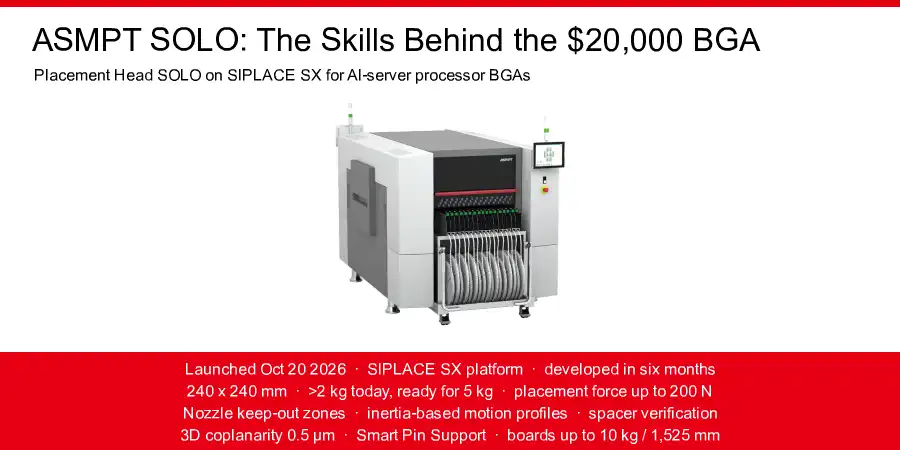
ASMPT Placement Head SOLO: The Skills Behind Placing a $20,000 Processor BGA
How do you put a component that costs more than a used car onto a circuit board — and be sure it lands safely, every single time?
On October 20, 2026, ASMPT SMT Solutions answered that question with a new tool: the Placement Head SOLO, developed in just six months for the SIPLACE SX platform and aimed squarely at the processor BGAs that power today’s AI servers. It is worth reading the announcement not only as a product launch, but as a checklist of the skills every SMT process engineer now needs when a single component costs more than US$20,000.
The numbers moved faster than most lines
ASMPT puts the pace in plain terms: one year ago, large processor BGAs measured roughly 150 × 150 mm and weighed around 500 g. The next generation already reaches 240 × 240 mm and more than 2 kg — about twice the footprint and four times the mass, on boards that can carry more than 20,000 placement positions. The SOLO head handles the full 240 × 240 mm class today, is already built for weights up to 5 kg, and delivers up to 200 N of placement force.
The head itself is engineered around that reality: a new single-segment architecture with a strengthened, stiffened axis, plus reinforced head-to-gantry and nozzle-to-segment interfaces to survive the mechanical loads that a 2 kg (and soon 5 kg) package generates.
Skill 1: Read the package spec as a handling spec
The SOLO’s nozzles are matched to the respective housing surfaces and respect areas that must not be touched during pickup. That detail is a skill statement: with multi-die modules, tall capacitors on the package top, and exposed interposer edges, the “keep-out map” is as important as the ball field. Before you write a single placement program for a giant BGA, get the package drawing, mark the no-touch zones, and confirm the nozzle design against them. On a $20,000 component, a generic nozzle choice is not a shortcut — it is a liability.
Skill 2: Program by inertia, not by speed
The SOLO takes the mass inertia of each large BGA into account in its motion profiles, so acceleration and rotational movements can be customized per component. That is the difference between “the machine can place 2 kg” and “the machine places this 2 kg component safely.” Treat the 200 N maximum as a capability envelope, not a setpoint: the process goal is the gentlest profile that still meets tact. Work with your equipment engineer to define component-specific acceleration and rotation limits, and record them in the recipe so the next NPI inherits them.
Skill 3: Support the board before the head lands
A processor BGA is only one component on a server board that may weigh up to 10 kg and stretch to 1,525 × 560 mm on the SX long-board option. Board deflection under a heavy head is the silent killer of large-BGA yield. The SIPLACE SX pairing matters here: heavy-duty conveyors for large, heavy boards, and SIPLACE Smart Pin Support, which positions support pins automatically and continuously monitors them. Make board support a first-class process parameter: verify pin maps for every new board revision, not just the first one.
Skill 4: Inspect the landing zone, not just the component
Before the processor is placed, the SX can inspect the target area in 3D for contaminants and verify the presence and correct position of spacers. Spacers set the standoff under these very large BGAs; a missing or misplaced spacer is a reflow defect waiting to happen — and a void problem you will chase for weeks. Build a pre-placement gate into your process: foreign-object check of the processor zone, spacer verification, and only then placement. This is exactly what ASMPT’s On-board PCB Inspection option was designed for.
Skill 5: Coplanarity is a measurement discipline
After pickup, the machine checks the BGA connectors optically and can optionally measure solder-ball coplanarity via 3D laser triangulation with vertical resolution down to 0.5 µm. On a 240 mm BGA with tens of thousands of balls, one low corner means an open joint or a void cluster. The skill is deciding when 3D coplanarity stops being an option and becomes mandatory — for example, whenever package mass, ball diameter, or reflow void limits tighten. Pair the measurement with your paste-printing data so a coplanarity alarm can be traced back to stencil, squeegee, or support.
Skill 6: Sequence is strategy
The processor is the last major component placed — after the CP20 has run the smallest parts (0201-metric class, up to 46,500 cph), the CPP has covered the broad middle spectrum (01005 to 50 × 40 mm, up to 23,850 cph), and the TWIN VHF has handled the heavy odd-shapes (up to 200 × 150 mm at 100 N and 300 g). The SOLO takes the final, most critical step. Why does the sequence matter? Because a defect discovered after the processor lands scraps far more than one component — it strands a board whose value is dominated by that single BGA. Line balancing for AI-server boards is therefore an economic exercise, not just a tact calculation: protect the last placement with everything upstream.
The key numbers at a glance
| Parameter | Placement Head SOLO / SIPLACE SX |
| Component size | up to 240 × 240 mm |
| Component weight | > 2 kg today, prepared for 5 kg |
| Placement force | up to 200 N |
| Platform | SIPLACE SX (SX1 43,250 cph / SX2 86,500 cph) |
| Placement accuracy | ± 25 µm @ 3σ |
| PCB size | 450 × 560 mm; long-board option 1,525 × 560 mm |
| Heavy-board handling | conveyors up to 10 kg + Smart Pin Support |
| Pre-place checks | 3D foreign-object inspection + spacer verification |
| Post-pick checks | optical BGA connector check; optional 3D coplanarity to 0.5 µm |
| Development time | six months, first for SIPLACE SX |
A checklist for the floor
If you are running — or buying — a line for AI-server boards, put these five items on the list:
- Head configuration on record: which heads (CP20 / CPP / TWIN VHF / SOLO-class) are fitted, and is the heavy-BGA capability actually licensed and installed?
- Support system: Smart Pin Support present, pin maps validated for your current board revisions.
- Inspection options: On-board PCB Inspection, spacer verification, and the 3D coplanarity sensor — confirm what is hardware, what is a software option.
- Conveyor rating: heavy-duty option for your real board weight, including long-board handling if your boards exceed 450 × 560 mm.
- Motion-profile library: component-specific acceleration/rotation limits documented in the recipes, so they survive operator changes.
One more thing worth knowing for the used-equipment market: the SIPLACE SX platform was explicitly built around Capacity on Demand — gantries can be added or removed in minutes as demand shifts. A used SX with the right head mix and inspection options is a far more future-proof buy than its cycle-time figure alone suggests, because the AI-server wave is re-rating what “the right head mix” means.
The bottom line
The Placement Head SOLO is ASMPT’s answer to a component class that doubled its footprint and quadrupled its mass in a single year. But the launch is also a quiet job description: placing a $20,000 processor safely is less about one heroic number and more about a set of skills — keep-out maps, inertia-based motion, board support, landing-zone inspection, coplanarity discipline, and placement sequence as economics. Machines now ship with most of those skills built in. Knowing which ones to switch on — and verify — is still yours.