
Koh Young Zenith UHS: Application of AI in AOI Equipment
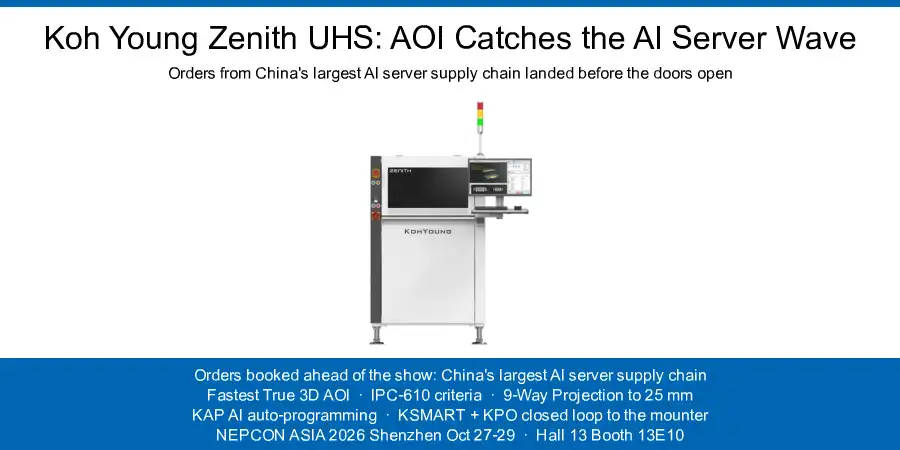
Application of AI in AOI Equipment
Timeliness angle · October 23, 2026
Two days ago, on October 21, Koh Young Technology did something most exhibitors save for the show floor: it disclosed results before the show opened. In its NEPCON ASIA 2026 announcement, the company confirmed it will exhibit at the Shenzhen World Exhibition & Convention Center (Bao’an) from October 27 to 29 — Hall 13, Booth 13E10 — and, more importantly, a company official stated: “Ahead of the exhibition, we secured new orders related to China’s largest AI server supply chain.”
The orders were booked before the doors even opened. That is the story of this cycle: AI server demand in China is no longer a forecast, it is a purchase order.
The numbers behind the timing
Research firm Rhodium Group projects that AI infrastructure investment by Chinese AI companies and related operators will reach roughly 932 billion yuan (about 188 trillion won) in 2026 — up 103% year over year. Koh Young also reported that the number of its China-based AI server customers grew in the third quarter of this year.
When the demand curve doubles in a year, the SMT line feels it in a specific place: the inspection bay. AI server boards are physically large, densely populated, and packed with high-value silicon. Every board carries tens of thousands of solder joints that must be judged before the board moves on. Cycle time pressure lands squarely on AOI.
What Koh Young is bringing to Shenzhen
The NEPCON ASIA lineup spans the full inspection stack: semiconductor inspection equipment, 3D solder paste inspection (SPI), 3D component placement inspection (AOI), 3D transparent-object inspection, and AI smart factory solutions. That last category — transparent-object 3D inspection — is the quiet tell. It exists because AI server and advanced-packaging boards increasingly hide joints under underfill, molding compound, and other optically unfriendly materials. The inspection mix is changing with the product mix.
At the center of the AOI story sits the Zenith UHS, positioned by Koh Young as the industry’s fastest True 3D AOI — the machine you pick when the board is big, the joint count is huge, and the tact time is not negotiable.
Zenith UHS: speed without giving up measurement
Three things define the Zenith UHS, and all three matter for AI server production:
1. True 3D measurement, not intensity guesswork. Koh Young pioneered projection moiré interferometry more than two decades ago, and the Zenith series remains the industry’s best-selling True 3D AOI line. The UHS measures actual profilometric component shapes — height, coplanarity, offset — quantitatively, and bases its acceptance criteria on IPC-610 standards. For a buyer, that distinction matters: a measurement-based judgment can be tuned, audited, and defended. An intensity-based one cannot.
2. Tall components are no longer the blind spot. Shadows cast by tall parts over neighboring short components have always been AOI’s classic weakness. The Zenith UHS attacks this with a multi-projection moiré system; with the optional 9-Way Projection configuration it inspects components up to 25 mm tall. AI server boards are full of tall connectors, power stages, and sub-assemblies — this is not an exotic option on those products, it is table stakes.
3. The AI loop is closed, end to end. Geometry-based KAP (Koh Young Auto Programming) uses AI to generate inspection programs automatically, cutting time-to-production. Upstream, KSMART collects data across the line for defect detection, real-time optimization, and traceability. And the loop goes all the way back to the machines causing the defects: KPO Printer takes control of squeegee speed, pressure, and stencil release variables, while KPO Mounter analyzes heads, nozzles, feeders, reels, and components from post-placement inspection data — then corrects feeder, nozzle, spindle, and skip behavior on the fly, before the solder joint is ever made. With SmartReview automating defect judgment, the biggest reductions are showing up in false calls and escapes — exactly the two costs that scale with board value.
Five questions to ask at Booth 13E10
If you are walking NEPCON ASIA next week, the AI server story is worth interrogating in person:
- Cycle time vs. your tact. Ask for the measured inspection area throughput at the resolution tier your boards need — the UHS ships in multiple resolutions and configurable options, and the honest answer lives at your resolution, not the best-case one.
- KAP in practice. How many boards does auto-programming typically need before stable production? AI programming is only a benefit if the review burden actually drops.
- The 9-Way Projection option. Is it hardware on the machine you are buying, or a retrofit? Check the BOM height distribution of your own products against the 25 mm ceiling first.
- KPO scope. Which correctable actions — feeder, nozzle, spindle, skip — are licensed and proven on your mounter brand? Closed-loop claims deserve a live demo.
- SPI-to-AOI data flow. Since 60–70% of solder joint defects originate at the printing step, ask to see the SPI-to-AOI-to-printer correction chain running on one board, not in three separate demos.
The second-hand angle
The Zenith line’s installed base is the deepest in True 3D AOI, which means a healthy second-hand market for years to come. When evaluating used units, the value is increasingly in the software and options, not just the optics: verify KAP and KSMART license status, confirm whether 9-Way Projection hardware is fitted, ask for moiré calibration records, and check the IPC-610 criteria library version. A ten-year-old frame with current software can outperform a newer frame that was bought stripped.
The takeaway
Koh Young booked its AI server orders before the show opened. Four days from now, Hall 13 in Shenzhen will be full of companies trying to understand exactly where those budgets are going — and the inspection bay, long treated as the line’s cost center, is clearly one of the destinations. In this cycle, timing is the story: measure your boards, close your loops, and get to the booth before the orders are someone else’s.