
BTU Pyramax: Profile the Oven, Not Just the Board
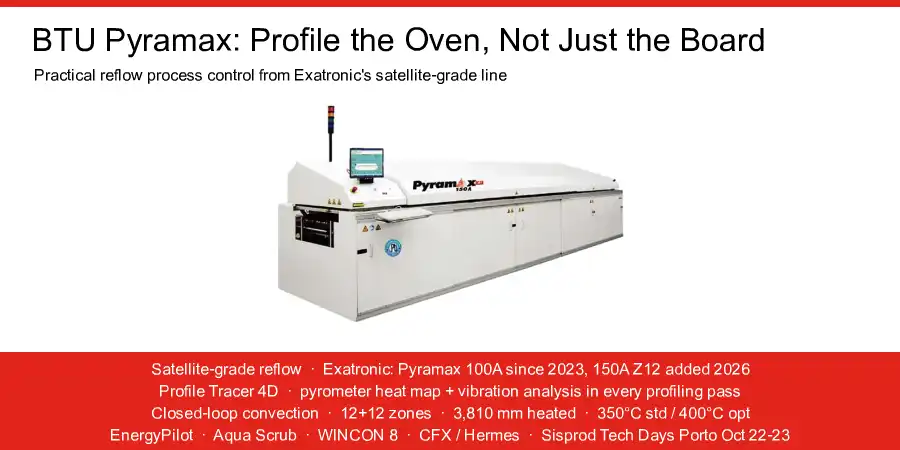
Practical reflow process control from Exatronic’s satellite-grade line
Some of the boards coming off Exatronic’s lines in Agueda, Portugal now fly on satellites. As CEO Nuno Gomes put it in BTU’s October 2026 announcement: “Some of our boards now fly on satellites, and nobody can repair them once they are launched.” That single sentence explains why the most interesting thing about this story is not the oven itself — it is what Exatronic measures around the oven.
If you can spare the time this week: BTU and iRaptor will both be at Sisprod Tech Days 2026, October 22–23 at the Centro de Congressos da Alfândega do Porto, walking through exactly this workflow.
The setup: one philosophy, two ovens, three years
In 2023, Exatronic invested in a BTU Pyramax 100A — an eight-zone (8 top / 8 bottom) convection reflow oven with a 2,540 mm heated length — together with iRaptor’s Profile Tracer 4D process optimisation kit. In 2026, as demand from aerospace and other high-reliability customers grew, they added a Pyramax 150A Z12: twelve zones top and bottom, 3,810 mm of heated length, in a machine roughly 6.5 meters end to end.
The 100A, they report, has stayed inside its process window since 2023. That is the part worth copying. Here is how the workflow actually works, and what you can practical-take from it.
1. Profile the oven, not just the board
A conventional profiler answers one question: did this board see the right temperature? The Profile Tracer 4D adds two more dimensions to the same profiling pass — a pyrometer heat map across the oven’s working width, and a vibration signature of the machine itself.
The heat map answers a question board profiling never asks: does zone 3 heat the left edge the same as the center? Edge-to-center deltas, an overheating zone, or a uniformity failure all show up as a picture instead of a mystery. Practical takeaway: every time you profile a board, you get an oven health check for free. No separate maintenance procedure, no extra downtime.
2. Track vibration like you track temperature
This is the genuinely unusual part. The 4D profiler carries an accelerometer, so each profiling run also captures the mechanical condition of the blowers and moving parts inside the oven. A blower bearing that is starting to drift will show up in vibration data long before it moves your thermal profile — which means you can schedule the intervention instead of chasing a profile that mysteriously wandered on Monday.
Practical takeaway: treat vibration like any other SPC chart. Establish an acceptable envelope right after commissioning, trend it per run, and act on the trend, not the single reading. This is what “machine-condition monitoring” looks like when it is bolted onto a workflow you already do.
3. Buy repeatability, then move recipes freely
BTU’s closed-loop convection control — side-to-side recirculation with feedback on actual heat transfer rather than blind setpoints — is what makes one oven’s recipe portable to the next. Exatronic explicitly applied “the same process-control philosophy” to the new 150A, and that is the quiet point of the story: when your ovens hold the same heat-transfer behaviour system to system and site to site, NPI on the second machine is a transfer, not a re-derivation.
4. The zone math: when 12 zones pay off
- Pyramax 100A: 8+8 zones, 2,540 mm heated length
- Pyramax 125A: 10+10 zones, 3,175 mm heated length
- Pyramax 150A Z12: 12+12 zones, 3,810 mm heated length (≈6,474 mm total with 1,219 mm cooling)
Twelve zones buy you profile real estate: gentler ramps for thick or large boards, longer soak flexibility for high-mix production, and headroom when boards grow. All Pyramax models run 350 °C standard with a 400 °C option, handle conveyor widths from 51 to 457 mm (610 mm / 24 in optional), and support panel-level work up to 700 × 700 mm. If your board mix is modest, an 8-zone machine plus disciplined profiling beats a 12-zone machine without the discipline — the oven is only half the system.
5. Uptime economics worth checking on any Pyramax
- EnergyPilot automatically cuts power and nitrogen consumption during production gaps, then recovers the profile before the next board.
- RecipePro (in WINCON 8) generates a starting recipe for new processes, cutting setup time.
- Aqua Scrub integrated flux management traps flux in a closed-loop water system with on-the-fly maintenance — no weekly deep cleans.
- Warranty: lifetime on heaters and blowers, 3 years system, 1 year labor. On a used oven, confirm what transfers.
- Connectivity: WINCON 8 speaks CFX, Hermes, OPC, REST and MQTT — the profile and condition data belongs in your MES, not on a USB stick.
The five-point checklist to take home
- Heat-map your oven’s width, not just its length — edge-to-center ΔT is where rework is born.
- Start a vibration baseline on day one of any new (or newly bought) oven.
- Write recipes against heat transfer, not setpoints, so they survive a machine move.
- Match zone count to board mix; do not buy zones you cannot discipline.
- Get profiling history with any used Pyramax — a seller who can show three years of in-window profiles is selling you a known machine.
Bottom line
Reflow is where reliability is won or lost — Gomes said that too, and a company whose product cannot be repaired in orbit has every reason to believe it. The Pyramax fleet is one of the largest installed bases in the industry, which makes this workflow unusually easy to adopt on machines you may already own. The oven is half the system; the profiling discipline is the other half — and that half goes home with you from Porto this week if you can make it.