
Fuji NXTR Places Tomahawk 6 Davisson: CPO Reaches SMT
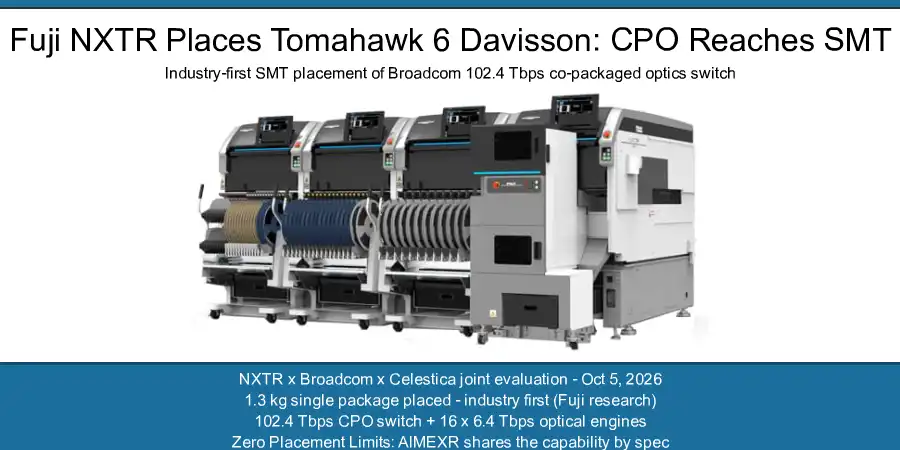
Fuji NXTR Places Tomahawk 6 Davisson
Angle: Innovation — when the machine that places 01005 chips is asked to place the internet’s next switch
October 5, 2026 — Fuji Corporation announced that it has demonstrated, in a joint evaluation with Broadcom and Celestica, the industry’s first SMT placement of Broadcom’s Tomahawk® 6 – Davisson, a 102.4 Tbps Ethernet switch built on co-packaged optics (CPO). A component weighing approximately 1.3 kg was transported and placed on Fuji’s NXTR pick-and-place platform, with transport performance and placement accuracy verified. Fuji adds that its large-panel machine, the AIMEXR, offers the same placement capability by design and machine specification.
Why this is a bigger deal than a press-release “first”
For thirty years, the SMT line has been an electrical world: chips, passives, connectors — nothing that shines. Pluggable optical modules lived one process step away, assembled elsewhere, plugged in after the board was built. CPO removes that boundary. In a co-packaged optics switch, the switch ASIC and the optical engines sit in the same package, eliminating most of the signal-loss penalty that plagues electrical links between the switch and its optics.
Broadcom’s Tomahawk 6 – Davisson (announced October 8, 2025) is the industry’s first 102.4 Tbps Ethernet switch with co-packaged optics, and its third-generation CPO design:
- 16 × 6.4 Tbps Davisson DR optical engines integrated on TSMC COUPE technology
- ELSFP laser modules that are field-replaceable — the optics are on the board, but the lasers can be swapped
- ~70% lower optical interconnect power versus conventional pluggable-optics architectures
- 200 Gbps per lane, scaling a single-tier cluster to 512 XPUs and a two-tier network beyond 100,000 XPUs
When the switch and the photonics become one package, that package has to go through a placement machine. Which is exactly what Fuji, Broadcom, and Celestica proved.
What the evaluation actually showed
Three things matter for anyone running an SMT floor:
1. Mass and stiffness, not just accuracy. A 1.3 kg switch package does not behave like an IC. It loads the placement head, the conveyor, and the vision system in different ways. Fuji verified component transport performance and placement accuracy — the two failure points that kill exotic-component introductions on real lines.
2. An EMS integrator was in the room. Celestica’s participation is the quiet headline. This was not a vendor bench demo; it was a contract manufacturer validating that the component can flow through a production-grade SMT process. That is how production qualifications actually start.
3. One machine family, two form factors. NXTR proved it in practice; AIMEXR carries the same capability on paper for large-panel work. AI-server and networking boards trend long and heavy — the 1500 mm-class panel territory — so having both platforms certified for the same component class matters for line planning.
The “Zero Placement Limits” bet
Fuji frames this under its Zero Placement Limits concept — a stated goal of reducing the set of components that cannot be placed to zero. Earlier in 2026, the same program delivered:
- 200 × 200 mm, 2.0 kg large heavy-component placement on standard NXTR and AIMEXR configurations (July)
- 016 × 008 mm (006003″) component placement — a world first at the opposite end of the size scale (January)
Put together, the trajectory is clear: Fuji is positioning the placement machine as the universal integration point — from the smallest passive to kilogram-class hybrid packages with photonics inside. As AI servers push co-packaged optics, retimer-heavy designs, and ever-larger packages onto conventional boards, “can the line place it?” is becoming the binding constraint, and machine makers are racing to erase it.
What to watch
- No production order was announced — this was a placement evaluation, and accuracy figures were verified but not published. Watch for a follow-up with quantified Cpk data.
- ELSFP field-replaceable lasers hint at a new service interface reaching the SMT-assembled board — rework and test strategies for optical engines will become an EMS skill worth pricing.
- For anyone sourcing equipment for AI-networking programs: ask your mounter vendor for their verified maximum package mass and CPO-package handling reference in writing. “Supports AI servers” marketing will outrun verified placement data for a while yet.
The boundary between SMT assembly and advanced packaging keeps dissolving, one component at a time. This October, a 102.4 Tbps switch crossed it.