
KIC Fan Speed Prediction: The Third Reflow Variable
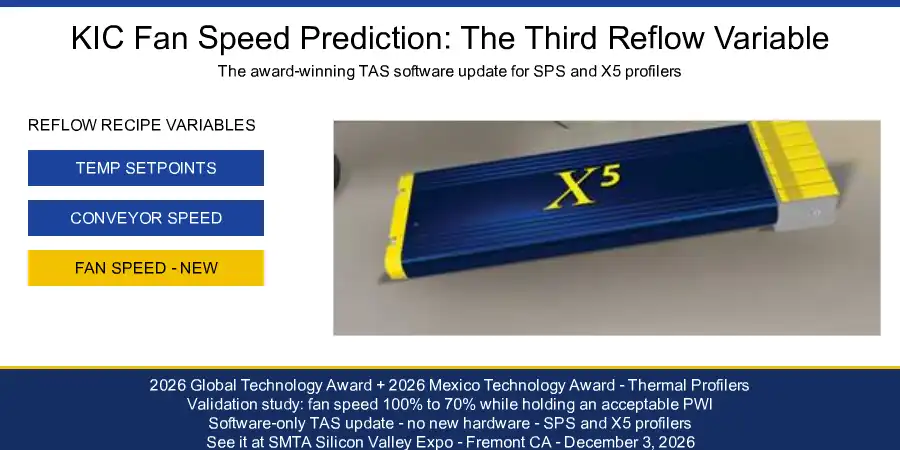
KIC Fan Speed Prediction: The Third Reflow Variable,For as long as most of us have run SMT lines, a reflow recipe has been a two-variable problem: zone temperature setpoints and conveyor speed. Tune those two, run the profiler, verify the profile, ship product. The third lever on the machine — convection fan speed — has sat at a fixed setting, invisible to the optimization math, even though airflow is what physically carries heat onto the board.
KIC’s Fan Speed Prediction changes that, and the industry has started paying attention. The technology won the 2026 Global Technology Award in the Thermal Profilers category, presented October 27, 2026 at SMTA International in Rosemont, Illinois, and the 2026 Mexico Technology Award. Both awards recognize the same idea: the industry’s first profiler-based solution to fold fan speed into the recipe prediction engine alongside temperature and conveyor speed — turning reflow recipe optimization from two variables into three.
Why airflow was the missing variable
Convection reflow ovens heat boards with moving air, so the heat transfer coefficient at the board surface depends directly on air velocity. Two recipes with identical zone setpoints can produce different ramps, peaks and cooling slopes simply because the fans blow harder. Until now, that dependency lived outside the prediction engine: engineers optimized setpoints and belt speed, and treated fan settings as fixed installation parameters.
That matters most at two moments. First, during changeover: moving from light boards to heavy boards usually means adjusting temperature setpoints, then waiting for the oven to thermally re-stabilize before the first good board. Second, during energy and wear accounting: fans running at 100% all day consume electricity and wear out motors and bearings faster than they need to.
What the third variable buys you
KIC’s stated benefits, in order:
- Changeover without the wait. Fan Speed Prediction can rebalance a recipe using fan speed and conveyor speed adjustments without changing oven temperature setpoints — which virtually eliminates oven stabilization time between product changeovers. In high-mix production, that is OEE you recover without buying anything.
- Lower fan speeds, same process window. In one validation study, TAS identified optimized recipes that reduced fan speeds from 100% to 70% while maintaining an acceptable Process Window Index (PWI). Less airflow means less energy consumption and less mechanical stress on oven fans and motors, extending equipment life.
- Prediction before production. Engineers can model how airflow changes affect board heating, reflow characteristics and cooling performance before running boards — reducing trial-and-error during process development and NPI.
How you get it
This is a software-only update: Fan Speed Prediction ships inside KIC’s Thermal Analysis System (TAS) software, which runs with the SPS Pro and X5 Pro smart profilers. No new hardware, no line modifications. For context on the hardware side: the SPS Pro samples up to 50 readings/sec at ±1.1 °C accuracy with 0.1 °C resolution in 7/9/12/24-channel configurations; the X5 Pro carries up to 224,640 data points per run. TAS already includes Navigator Power™ optimization (center of window, maximum conveyor speed, or minimum electricity use) and the new Common Recipe Finder™ for changeover efficiency — Fan Speed Prediction extends that engine with the airflow dimension.
Buyer’s checklist
- Check your oven’s fan control granularity. The third variable only exists if your oven can actually vary fan speed — per zone or globally. Fixed-speed fan ovens cannot benefit; ask your oven supplier which zones have independent, controllable blowers.
- Check your TAS version. Existing SPS/X5 users may already be one software update away from the feature. Ask KIC or your distributor to confirm eligibility.
- Set an internal PWI target first. The 100%→70% result held an acceptable PWI — define what “acceptable” means in your house spec before letting the optimizer lower airflow.
- Second-hand oven buyers, take note. When comparing used convection ovens, controllable fan speed per zone is now worth real money: it is what allows newer profiling software to cut changeover time and energy cost on your floor.
Where to see it
KIC will demonstrate Fan Speed Prediction at the SMTA Silicon Valley Expo & Tech Forum, Thursday, December 3, 2026, in Fremont, California.
The oven always had three dials. It took a profiler company to make the third one useful.