
Fuji AIMEXR: The 2 kg Placement Envelope for AI Server Boards
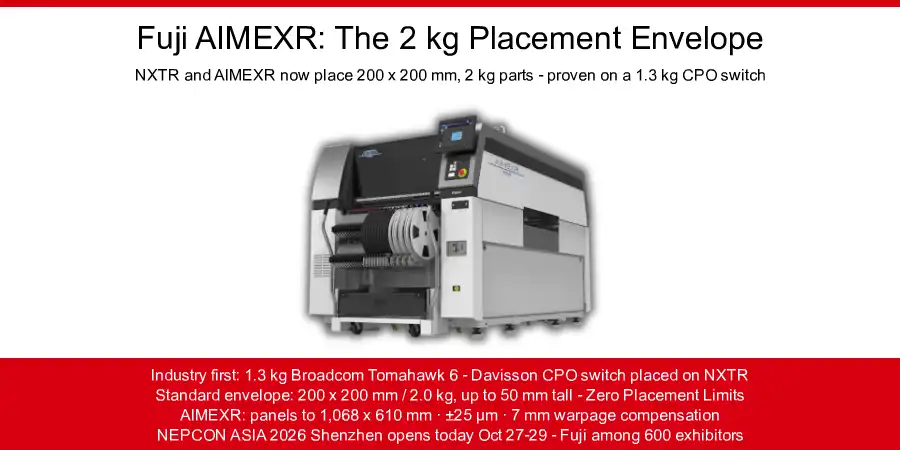
Fuji AIMEXR The 2 kg Placement Envelope
Angle: Timeliness — NEPCON ASIA 2026 opens today (October 27–29, Shenzhen) with Fuji among the 600 exhibitors, and Fuji’s newest placement-envelope news (October 5 Japan / October 19 Europe, 2026) is the number to check on the show floor.
This morning, two of the industry’s biggest shows opened their doors on the same day: NEPCON ASIA 2026 in Shenzhen (October 27–29, Shenzhen World, Bao’an) — 600+ exhibitors, 200+ new product debuts, Fuji among them — and SMTA International 2026 in Rosemont, Illinois (October 27–29). If you walk either floor this week and ask one question about AI server board assembly, make it this one: how heavy a component can your mounter actually place?
Fuji has a concrete answer, published just weeks ago.
The 1.3 kg First
On October 5, 2026, Fuji announced that it had achieved the industry’s first successful SMT placement of Broadcom’s Tomahawk 6 – Davisson, a next-generation Ethernet switch built on Co-Packaged Optics (CPO) technology. The evaluation was conducted jointly by Broadcom, Celestica, and Fuji, on a Fuji NXTR placement machine, verifying both component transport performance and placement accuracy.
Why does a 1.3 kg switch deserve headline treatment? Because of what it represents. CPO packages integrate the switch ASIC and the optical engines into a single body, cutting signal-transmission power loss in AI data-center networks. That integration makes the package physically big and heavy — and it sits on top of a board already crowded with GPUs, ASICs, and HBM. The Tomahawk 6 – Davisson is also Broadcom’s first 102.4-Tbps CPO Ethernet switch, announced in October 2025, so production demand is arriving now, not hypothetically.
According to Fuji’s own research, no other SMT placement equipment has demonstrated placement of this specific component. That is a “first” worth planning around.
The Standard Envelope Moved
The more consequential number came in Fuji’s October 19 release from Fuji Europe: in their standard configurations, both NXTR and AIMEXR can now handle components measuring up to 200 × 200 mm and weighing 2.0 kg — again, by Fuji’s research, a first among manufacturers, demonstrated under Fuji’s own evaluation conditions.
Put that next to where the industry stood recently: large processor BGAs were in the 150 × 150 mm, 500 g class. The new generation of AI packages has roughly doubled the area and multiplied the weight several times over. Fuji’s “Zero Placement Limits” program now spans from 016008 micro-components on the small end to 200 × 200 mm / 2 kg packages, with component heights up to 50 mm currently supported. The direction of travel is explicit: Fuji intends to keep pushing the envelope as next-generation packages grow larger and heavier.
For the heaviest processor class, Fuji also confirmed that the AIMEXR, its large-panel placement machine, has the placement capability for the Tomahawk 6 – Davisson based on machine design and specifications.
Why AIMEXR Is the Machine to Watch
The NXTR got the demonstration, but the AIMEXR is the platform built for the boards these packages live on:
- Panels up to 1,068 × 610 mm — the territory of AI server, communication-infrastructure, and automotive boards
- ±25 µm placement accuracy, regardless of head type or component, with controlled push-in pressure
- Panel warpage compensation up to 7 mm — critical on large, thin boards that warp under thermal load
- Up to 130 part types on board, enabling shared setups and fewer changeovers in high-mix production
- The same advanced heads as NXTR, so line balancing and part-range coverage carry over between machines
- IPS defect checks, optional LCR and coplanarity verification, offline nozzle/feeder/head maintenance, and on-machine program editing for fast NPI ramp
In other words: one platform that can both fill a 1 × 0.6 m server panel with thousands of small parts and finish it with a 2 kg, 200 × 200 mm package — without sending the board to a second machine.
What to Ask This Week
If you are at NEPCON ASIA in Shenzhen or SMTAI in Rosemont over the next three days, the timeliness checklist is short:
- Ask for the 1.3 kg CPO placement data — transport performance and placement accuracy results from the Broadcom/Celestica evaluation.
- Ask what “standard configuration” means for the 200 × 200 mm / 2 kg envelope — which heads, which nozzles, and whether heavy-part programs account for component mass inertia.
- Ask how AIMEXR supports a 2 kg package on a warped 1 m panel — board support, warpage sensing, and push-in control working together.
- Ask about the used-market angle: which NXTR-generation machines can accept these packages today, and what an upgrade path looks like for existing lines.
AI server boards are resetting the definition of a “large component” faster than most lines can retool. As of today’s show openings, Fuji has the published proof — and the machines on the floor to see.