
ASMPT SIPLACE V: The Setup Skills That Turn 52,500 CPH Into Real Output
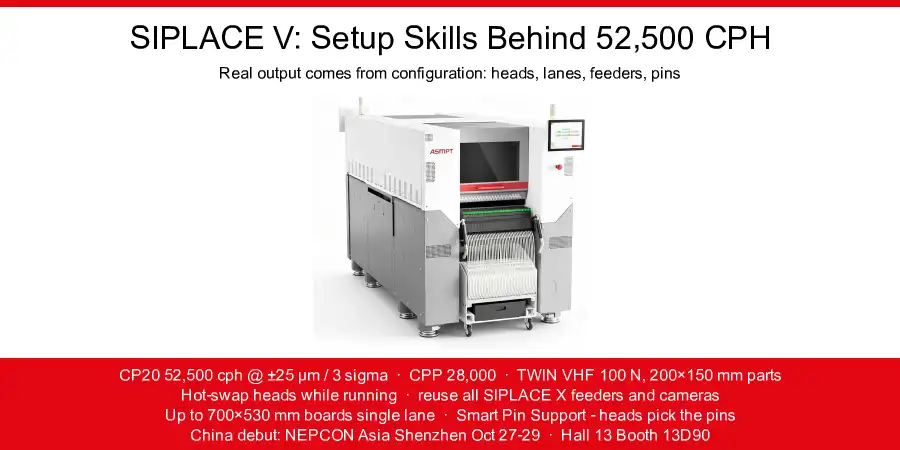
Turn 52,500 CPH Into Real Output
Every placement machine has a rated speed. Only well-configured lines actually ship at it. ASMPT’s new SIPLACE V platform — making its China debut at NEPCON Asia 2026 in Shenzhen (October 27–29, Hall 13, Booth 13D90) — claims up to 30% more performance under real production conditions, and a benchmark rate above 52,500 components per hour from a single head. But the platform only pays that dividend to manufacturers who know how to configure it. Here are the setup skills that separate a spec sheet from a shipping line.
Turn 52,500 CPH Into Real Output Skill 1: Match the head to the product mix — then swap it without stopping
The SIPLACE V ships with three placement heads, and choosing between them is the first skill:
- CP20 — the speed head. Up to 52,500 cph at ±25 µm (3σ), covering everything from 016008M chips up to 8.2 × 8.2 × 4 mm. This is your mainstream head for consumer, automotive, and IT boards.
- CPP — the flexibility head. Up to 28,000 cph, components to 50 × 40 × 15.5 mm, and it switches between collect-and-place, pick-and-place, and mixed modes by software command. For high-mix lines that live on quick changeovers, this head removes head-change downtime from the equation.
- TWIN VHF — the force head. Up to 6,000 cph at ±20 µm, placement force up to 100 N, parts to 200 × 150 × 28 mm and 300 g. Built for connectors, heavy BGAs, and odd-shaped components.
The real skill: all three use a universal head interface, so heads can be exchanged through a central port while the machine keeps running. A line that places 03015 chips in the morning and 200 mm odd-forms in the afternoon no longer needs a head-change stop.
Skill 2: Configure the lane for the board, not the brochure
SIPLACE V comes in single- and dual-gantry versions with single- or dual-track conveyors, and the choice changes what the machine is good at:
- Dual conveyor: boards up to 400 × 280 mm — best for high-volume, small-to-mid board lines where two lanes smooth the flow.
- Single conveyor: boards up to 700 × 530 mm — the configuration for large-format work, and the natural partner to the new DEK TQ XL printer (850 × 610 × 8 mm boards, 12-second cycle, ±20 µm print accuracy at 2.0 Cpk).
Add up to two tray units per machine, and remember that the new platform squeezes all of this into a 1.1 × 2.4 m footprint — a record floorspace-to-output ratio. If your floor plan is the constraint, measure before you buy.
Skill 3: Reuse everything you already own
The least glamorous but highest-ROI setup skill is inventory reuse. SIPLACE V is fully compatible with existing SIPLACE X feeders, cameras, and software — the entire WORKS suite carries over. For a factory running SIPLACE X today, the upgrade path is a machine swap, not a line rebuild.
Two feeder-side features reward attention during line design:
- SIPLACE Measuring Feeder — verifies electrical component properties before placement, catching mixed or wrong-value reels upstream.
- SIPLACE Power Connector X — keeps feeders powered online, so preparation and troubleshooting happen without stopping the machine.
Skill 4: Let the machine do the pin work
On most lines, support-pin setup for large boards is a manual, error-prone step. On SIPLACE V, Smart Pin Support positions support pins automatically — and the placement heads pick the pins themselves, eliminating the separate pin picker entirely. Combined with the optional 3D coplanarity module, individual component inspection, and seamless traceability, the platform absorbs several tasks that used to live in an operator’s head.
That is the honest meaning of “autonomous”: fewer manual interventions, fewer setup mistakes, and process quality that does not depend on who is on shift. Zollner Elektronik’s field test — 25,000 assembled modules and 7.3 million components in high-mix, low-volume production — confirmed the gains in effective output, not just lab benchmarks.
Skill 5: Close the loop with data
Finally, the skills that keep the platform fast next year, not just today. ASMPT’s WORKS Software Suite and Factory Solutions handle scheduling, material flow, traceability, and closed-loop maintenance of heads, feeders, and nozzles. The latest Virtual Assist adds an AI chat that holds a conversation — including follow-up questions — and identifies spare parts from a smartphone photo of a disassembled component. When SPI and AOI data feed back into placement recommendations, the line tunes itself toward the yield numbers you originally budgeted for.
The takeaway
A 52,500 CPH machine is an opportunity, not a guarantee. The factories that capture SIPLACE V’s 30% are the ones that configure heads around their product mix, pick lanes for their real board sizes, carry over their feeder fleet, automate pin support, and wire inspection data back into the process. Master those five setup skills and the platform’s speed becomes your throughput — and you can watch all of it demonstrated at ASMPT’s Booth 13D90, NEPCON Asia, Shenzhen World Exhibition & Convention Center, October 27–29, 2026.