
Yamaha YRH10W: One Machine for Bare Dies and SMD Placement
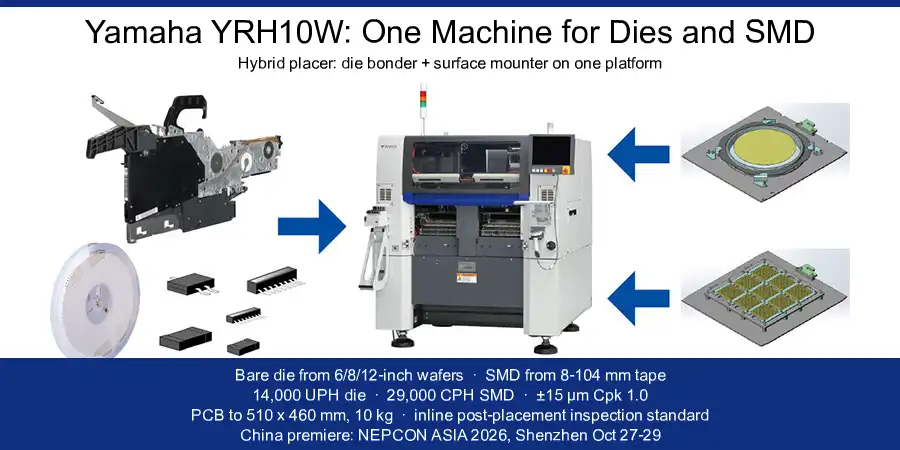
One Machine for Bare Dies and SMD Placement
Angle: Innovation · Brand: Yamaha Robotics SMT Section · Date: 2026-10-28
Every electronics factory that builds power modules, sensor modules, or SiP-style assemblies lives with the same split personality. The bare die comes off a wafer and needs die-bonding accuracy. The passives, connectors, and controllers around it come off tape reels and need SMT speed. Tradition says: buy a die bonder for the chips, buy a surface mounter for everything else, and live with two capital purchases, two software environments, and a WIP queue sitting between them.
Yamaha’s answer is to erase the boundary. The YRH10W hybrid placer — launched March 1, 2026, and making its China premiere this week at NEPCON ASIA 2026 in Shenzhen (Oct 27–29) — does die bonding and SMD placement on one platform.
What “hybrid” actually means here
The YRH10W is a wide-type evolution of Yamaha’s YRH10 hybrid placer. In one machine it handles:
- Bare dies picked directly from wafers — 6-inch, 8-inch, and now 12-inch wafers, up to 10 wafer types loaded at once, dies from 0.35 × 0.35 mm up to 16 × 16 mm and 0.1–0.5 mm thick.
- SMD components from tape reels — 8 to 104 mm tape, up to 64 reel types, from 0201 chips up to 16 × 16 mm / 15 mm tall parts.
One machine, one program environment, one SECS/GEM-ready data stream. The wafer units and the feeders share the same placement head, the same vision system, and the same inline post-placement inspection that ships as standard.
The numbers that make it credible
Hybrid machines have existed before; the question is always whether the die-bonding half keeps up with packaging-class expectations. The YRH10W’s spec sheet answers directly:
| Spec | YRH10W |
| Bare-die placement (wafer supply) | 14,000 UPH |
| SMD chip placement | 29,000 CPH |
| Placement accuracy | ±15 µm, Cpk ≥ 1.0 |
| Wafer compatibility | 6 / 8 / 12-inch |
| Die size | 0.35 × 0.35 mm to 16 × 16 mm |
| PCB size | L50 × W60 mm to L510 × W460 mm |
| PCB thickness / weight | 0.8–20 mm / up to 10 kg |
That ±15 µm figure with Cpk ≥ 1.0 is packaging-equipment territory, and it’s held by Yamaha’s MACS multi-axis calibration plus the thermal compensation and optimized axis control inherited from the YRH10.
Built for the way modules are actually made
Two design decisions show Yamaha understood the application. First, the large carrier capability: power modules for NEVs are increasingly mounted in batch, with multiple units arranged on one large carrier. That’s why the YRH10W transports boards up to 510 × 460 mm, 20 mm thick, 10 kg — the high-rigidity conveyor that keeps placement accuracy stable also carries the carrier.
Second, the quality chain around the die. Mounting Height Compensation and Load Control measure PCB height and warpage before each placement. The All Image Tracer saves every component recognition image, so when a joint fails days later you can walk back to the exact pickup and recognition data that placed it. And the Wafer Pickup Condition Setup Utility is visual — operators set wafer pickup parameters on screen without special skills, which is exactly what a hybrid machine needs if it’s to live on an SMT floor rather than in a packaging cleanroom.
Why the innovation matters more than the spec
The strategic point: the line between “SMT factory” and “packaging line” is dissolving. Power modules went mainstream with EVs. Sensor modules and AI hardware keep pulling bare die and SMD parts into the same assembly. A 12-inch wafer shift across the semiconductor industry is cutting die costs — which pushes more bare-die work toward module builders who historically only ran SMD.
Against that backdrop, a machine like the YRH10W is a genuine third option: instead of a dedicated die bonder (expensive, single-purpose) or a conventional mounter (can’t touch a wafer), you get one platform that covers both processes and reconfigures as the product mix changes. For high-mix module producers, that’s less duplicated capital, less floor space, and no handoff queue where dies wait between two machines.
Yamaha exhibits the YRH10W and its 1 STOP SMART SOLUTION line at NEPCON ASIA 2026, Shenzhen World Exhibition & Convention Center, October 27–29, 2026 — its first showing in China.