
Hanwha DECAN S2 Plus: The Upgrade Math for an Aging SMT Line
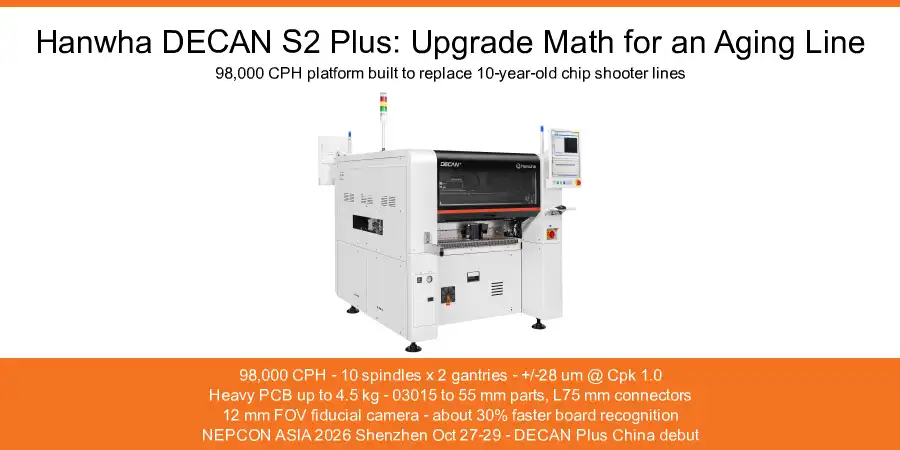
Hanwha DECAN S2 Plus
Walk any ten-year-old SMT shop in the Pearl River Delta and you will hear the same sentence: “the old chip shooter still runs, so we keep maintaining it.” Hanwha Semitech walked into NEPCON Asia 2026 in Shenzhen (October 27-29) with a pitch aimed exactly at that sentence. Alongside its HM520 + HM520W inline solution and the T-Solution software suite, the company debuted the DECAN Plus series in China for the first time – and said out loud what most vendors only imply: this machine is built for factories replacing aging equipment.
The flagship of that debut is the DECAN S2 Plus. Here is the practical math behind it.
What the Hanwha DECAN S2 Plus spec sheet actually says
| Item | DECAN S2 Plus |
| Placement speed | 98,000 CPH (10 spindles x 2 gantries) |
| Accuracy | ±28 µm @ Cpk ≥ 1.0 (chip) / ±30 µm @ Cpk ≥ 1.0 (QFP) |
| Component range | 03015 – □16 mm (fly) / up to □55 mm, L75 mm connectors (fix) |
| Heavy PCB | up to 4.5 kg |
| Footprint | L1,430 x D1,740 x H1,995 mm |
| Fiducial camera | 12 mm wide FOV, ~30% faster board recognition |
Two numbers deserve a second look if you are running a mature line.
98,000 CPH against a realistic uptime. Launch coverage at SSPA 2026 in April quoted 95,000 CPH; the current spec sheet says 98,000. Either way, the relevant question is not the brochure peak – it is what the machine holds at your actual uptime. A two-gantry, ten-spindle platform holds rated speed better than a single-gantry machine pushed to its limit, because neither gantry is the bottleneck. For a shop replacing an early-2010s shooter rated around 60-70k CPH, that is a 30-50% throughput step without adding floor space.
4.5 kg heavy PCB support. This is the quiet headline. AI server boards, automotive power boards and network backplanes are heavier and thicker than the consumer boards older lines were designed around. If your current machine’s conveyor and support pins were never rated for 4.5 kg, the “cheap” option – keeping the old line – quietly becomes a handling-risk option. The S2 Plus was reinforced for exactly this segment: Hanwha is pointing the whole series at AI servers, networking equipment and automotive electronics.
Where the Hanwha DECAN S2 Plus upgrade actually pays back
Raw speed is easy to compare on paper. The less obvious payback lives in changeover time, and this is where the Plus refresh concentrates its engineering:
- ~30% faster board recognition from the new 12 mm wide-FOV fiducial camera. Every new job starts with fiducial finding; cut a third off that step and it compounds across every NPI, every shift, every board size change.
- Automatic mounting-point teaching and a first-article mounting mode. The next-generation vision confirms mounting points automatically and calibrates precisely, which shortens the most expensive part of an NPI – the first hours when a new program runs on real components. Less trial-and-error means fewer scrapped first boards and fewer engineer-hours per new product.
- Large touch monitor with an expanded display. Multiple screens shown simultaneously, touch plus mouse operation. It sounds cosmetic until you count how many minutes per shift your operators spend navigating nested menus on an old pendant-style interface.
Same 1,430 mm length and 1,740 mm depth as the DECAN platform’s recent generations – the S2 Plus is meant to drop into the line slot an aging DECAN already occupies, without re-approving the line layout.
The buyer’s checklist before you sign
If you are pricing an upgrade (or comparing a new S2 Plus against a used DECAN S2), ask these five questions:
- Feeder compatibility. Can your existing DECAN feeder fleet and trolleys carry over? Mixed-fleet shops lose much of the upgrade savings re-buying feeders.
- Heavy-board configuration. Confirm the 4.5 kg support option (rail width, edge support, program limits) is on the quote for your actual board – not just “standard.”
- Vision option package. The ~30% recognition gain and auto teaching are the Plus-generation features; verify the configuration includes the high-speed fiducial camera, not a carry-over module.
- Software integration. Ask how T-Solution (materials management, production planning, real-time monitoring) connects to your MES, and whether the AMR material-transport option demonstrated at the show is available in your region.
- The used-market side. The S2 Plus push will eventually push clean, late-model DECAN S2 units onto the second-hand market. If 98,000 CPH is more than your mix needs, that is where the value math flips the other way.
Last call at Shenzhen
NEPCON Asia 2026 – 600+ exhibitors and roughly 70,000 visitors at the Shenzhen World Exhibition & Convention Center – closes today, October 29. If an equipment-refresh decision is on your 2027 budget, the Hanwha Semitech booth’s DECAN Plus China debut is worth the trip; otherwise, the spec sheet above is the practical summary of what has changed.