
ASMPT DEK TQ XL: The Solder Paste Printing Skills That Decide SMT Yield
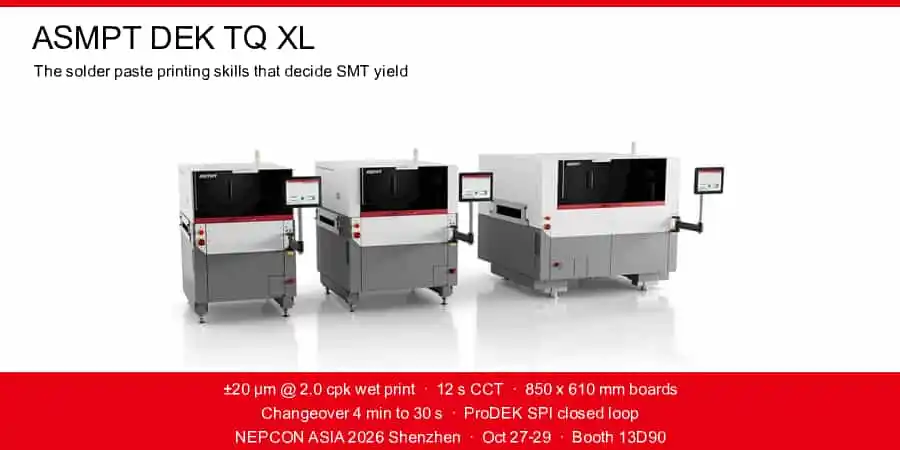
Angle: Skills — the craft that lives at the stencil printer, and how the new DEK TQ XL takes over the hardest parts of it.
Ask a veteran process engineer where SMT yield is actually won, and the answer rarely mentions the fastest placement machine on the line. It points two stations upstream, to the stencil printer. Industry estimates consistently attribute 60–70 percent of all solder defects back to solder paste printing — which means the most consequential skills on any SMT line are printing skills: how you set pressure, speed and separation, how you manage the stencil and the paste, and how you read the data that comes back from SPI.
With ASMPT bringing the DEK TQ XL printer to NEPCON Asia 2026 in Shenzhen (October 27–29, Booth 13D90, Hall 13), it is a good moment to walk through those skills — and to see which of them the machine now does for you.
1. The parameter trio: pressure, speed, separation
Every good print starts with three numbers, and every bad print starts with one of them drifting.
- Squeegee pressure. Too low and paste is left sitting in the apertures; too high and the blade scoops paste back out of the deposit and wears the stencil. Most lines settle somewhere around 5–15 kg of total blade force for a full-size squeegee, then tune by result, not by feel.
- Print speed. Typical windows run 30–80 mm/s. Fine apertures and Type 4/5 powders want the slow end; going slower costs cycle time but buys release consistency.
- Separation speed. After the print stroke, the board must drop away from the stencil in a controlled way. Snap off too fast on fine-pitch work and you pull peaks and strings into the deposit.
The symptoms are easy to list — bridging, insufficient volume, slumping, grinning — but the diagnosis skill is knowing which of the three knobs moved, and that only comes from disciplined, one-variable-at-a-time experiments.
2. Stencil and paste discipline
The printer only amplifies what the stencil and the paste bring to it:
- Aperture design. Keep the area ratio in the 0.55–0.65 range; use stepped or reduced apertures on 0.4 mm-pitch QFNs and large thermal pads on the same board.
- Paste handling. Store at 2–10 °C, temper sealed for at least 4 hours, mix to the vendor’s spec, and match powder size (Type 4 and finer for 03015/01005 work). Paste that has sat on the stencil overnight does not behave like fresh paste — top-up rules matter.
- Under-stencil cleaning. Dry, wet and vacuum cycles each remove different residue. Solvent choice and wipe frequency are process decisions, not defaults.
None of this is glamorous. All of it shows up in your defect Pareto.
3. What the machine now holds: the DEK TQ platform
The interesting shift in recent DEK generations is how much craft has been engineered into the platform. The DEK TQ series pairs a linear-motor-driven print head with a rigid frame and a machine alignment capability of ±12.5 µm at >2.0 Cmk (±6 sigma), and its new clamping process supports belt-off printing for clean separation. Around the core, ASMPT has added high-speed under-stencil cleaning, intelligent paste management, automated stencil and squeegee changeovers, and closed-loop control over open interfaces (IPC-HERMES-9852, IPC-CFX) — with ProDEK tying SPI volume, height and offset data back into the print recipe so the line corrects drift by itself.
The headline number at NEPCON Asia belongs to the DEK TQ XL, built for AI server and high-performance-computing boards: stencil printing for boards up to 850 × 610 × 8 mm, a core cycle time of just 12 seconds, and wet-print accuracy of ±20 µm @ 2.0 cpk. The new automated setup changeover cuts what used to be roughly four minutes of manual changeover down to 30 seconds. The sibling DEK NeoHorizon 03iX — a used-market favorite — carries the same discipline for conventional boards: 8-second core cycle time, wet print better than 2.0 cpk at ±25 µm, a 510 × 508.5 mm print area, and the Instinctiv V9 software interface.
4. Buying a used DEK? Check the skills it kept
Printing know-how matters twice in the second-hand market: once when you set the machine up, and once when you inspect it. Before you commit:
- Run a repeatable alignment verification (Cmk/CPK print test), not just a dry cycle.
- Inspect squeegee blades and holders for wear, and check stencil frame and tension condition.
- Test the under-stencil cleaning system in all three modes — dry, wet, vacuum.
- Confirm software status: Instinctiv V9 version, ProDEK / SPI closed-loop licensing.
- Look at belt, rail and camera condition and the service log; belt-off clamping hardware must be intact.
A DEK that passes those checks carries the factory process discipline — the printed skill — into your line at a fraction of the price.
The takeaway
The fastest way to raise SMT yield is still to get better at printing, whether that means training people or buying a platform where the machine holds more of the skill. If you are in Shenzhen this month, DEK TQ XL is on stage at NEPCON Asia 2026 (October 27–29, Booth 13D90, Hall 13) — and if a used DEK NeoHorizon 03iX fits your budget, the printing skills it embeds are the same ones the show floor is advertising.