
Fuji NXTR S Places the Industry’s First Broadcom Tomahawk 6 CPO Switch
Angle: Innovation — the placement frontier moves to co-packaged optics
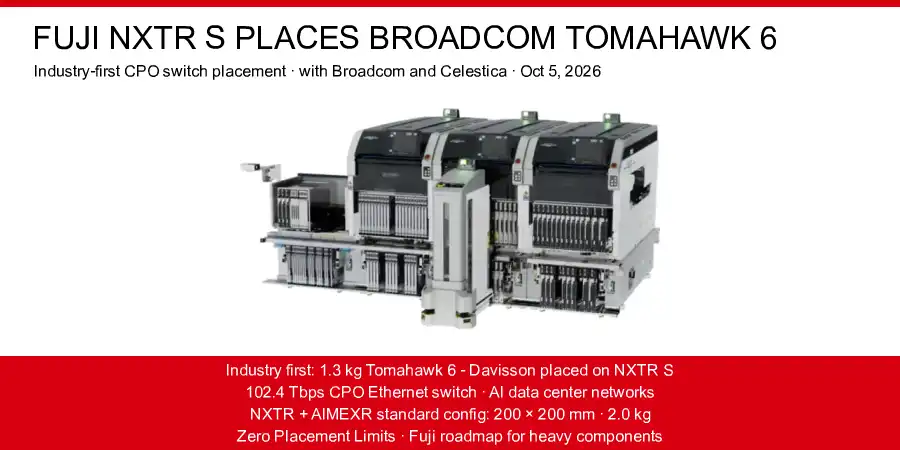
On October 5, 2026, Fuji Corporation announced something no other SMT equipment supplier has publicly demonstrated: the successful SMT placement of Broadcom’s Tomahawk® 6 – Davisson, a co-packaged optics (CPO) Ethernet switch, on its NXTR S pick-and-place platform. The evaluation was conducted jointly by Broadcom (California, USA), Celestica (Toronto, Canada) and Fuji, and it verified both component transport performance and placement accuracy. Based on Fuji’s research as of that date, Fuji machines are the first in the industry to demonstrate SMT placement of this component.
Why one component matters this much
The Tomahawk 6 – Davisson is not an ordinary switch chip. When Broadcom introduced it on October 8, 2025, it was announced as the industry’s first 102.4-Tbps Ethernet switch with co-packaged optics. CPO integrates the switch ASIC and the optical engines into a single package, which is exactly what makes it attractive for AI data centers: it cuts the power loss associated with high-speed signal transmission, a decisive factor when a single cluster interconnects thousands of GPUs and AI accelerators.
The catch for anyone who builds electronics is that CPO packages are physically imposing. The Davisson component used in the evaluation weighs approximately 1.3 kg. A component of that mass and size changes the conversation at the placement stage — transport, pickup, alignment and release all have to be re-engineered, because a placement head designed for 0201s and BGA trays was never assumed to lift 1.3 kg with repeatable accuracy.
What the evaluation actually verified
Two things were demonstrated on the NXTR S platform, and both matter more than the headline number suggests:
- Component transport performance — the package moves through the machine without the handling failures (dropped pickups, rail jams, vision misreads) that heavy, non-standard bodies usually cause.
- Placement accuracy — the package lands within specification, so it is a production-capable result, not a laboratory stunt.
Fuji also confirmed that its AIMEXR platform, the pick-and-place machine designed for large panels, offers the same placement capability based on its design and machine specifications. That gives AI-server and networking-equipment builders two routes: the modular NXTR S line for mixed production, and AIMEXR where panel size dominates.
The roadmap behind the milestone
This result did not appear from nowhere. On July 30, 2026, Fuji announced that the standard configurations of both NXTR and AIMEXR can handle large, heavy components measuring 200 × 200 mm and weighing 2.0 kg — another industry first. In other words, the Tomahawk 6 placement is the second step on a deliberate path. Fuji groups both milestones under a single concept: Zero Placement Limits — reducing the placements that cannot be done to zero, one restriction at a time.
For context, the NXTR S platform that carried the evaluation is no slouch on conventional work either: the RH20 rotary head delivers 46,000 cph (50,000 cph in productivity-priority mode) at ±0.025 mm placement accuracy (Cpk ≥ 1.00), with panel handling from 48 × 48 mm up to 750 × 610 mm on a 1R module — the largest in its class — and nozzle coverage from φ0.2 to φ20.0 mm.
What it means for SMT engineers and buyers
Three practical takeaways:
- Check your component mass spec now. If you quote AI-server, switch or optical-module work, ask what your current mounters are rated for beyond the standard component library. The 200 × 200 mm / 2.0 kg class is becoming a real requirement, not a datasheet footnote.
- Board handling is the quiet bottleneck. A 1.3 kg package is also a heavy, stiff carrier for conveyor, support and clamping systems. Placement capability only counts if transport and support keep up.
- Capability cascades. Features that debut on AI-server lines — heavier component handling, large-panel transport, warpage-aware placement — become the selection criteria for the next generation of mainstream and used equipment.
The second-hand market angle
None of this makes today’s installed base obsolete overnight, but it does sharpen the question every used-equipment buyer should ask: what was this machine actually built to place? As AI-server assembly moves from flagship EMS lines to the broader market, platforms like the NXTR series — modular, large-panel capable and backed by Fuji’s Zero Placement Limits roadmap — are the ones whose value holds.