
JUKI RX-6: How a High-Mix EMS Line Turned Flexibility Into Throughput
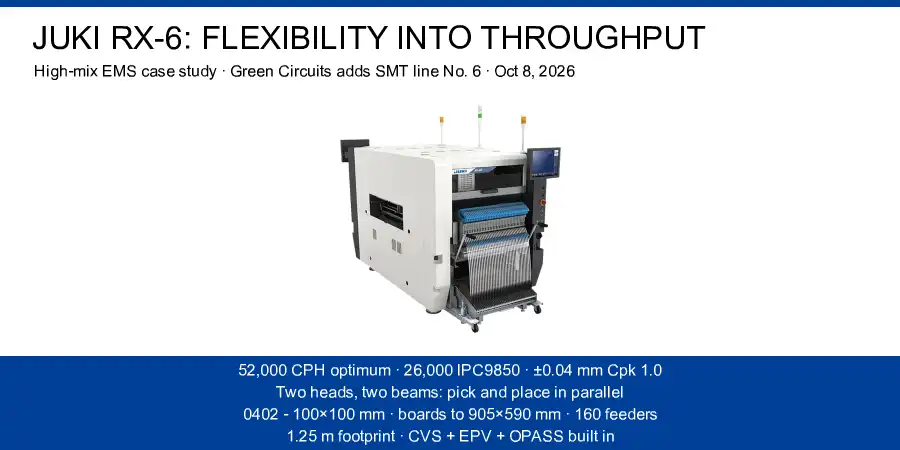
On October 8, 2026, US EMS provider Green Circuits announced that its sixth SMT line is running at the San Jose facility — a capacity increase of roughly 20 percent, with a seventh line about to ship and an eighth and ninth already at the quotation stage. The placement backbone of the new line: two JUKI RX-6 dual-gantry mounters, fed by a JUKI G-Titan screen printer and an FX-3 chip shooter, with a Nordson SE-600 3D SPI system up front and a 14-zone Vitronics Soltec Centurion reflow oven — its 20-foot tunnel sized for high-layer-count boards and assemblies carrying 4- to 6-ounce copper — at the back.
Why does this matter to anyone running a mixed-product floor? Because Green Circuits did not pick its placement platform on peak speed alone. COO Mark Evans put it plainly: “Juki’s flexibility allows us to efficiently handle the variety of products and component sizes that move through our factory, while the dual-gantry RX-6 machines provide a significant productivity advantage over some of our older platforms.” Flexibility and fast changeovers, in his words, matter as much as speed in high-mix production. Here is how the RX-6 delivers that in practice — and what to look for if you are shopping the used market.
1. What dual-gantry actually buys you
Each RX-6 carries two head units on two independent beams, and each head has its own on-the-fly laser centering system. While one head is placing, the other is already picking and centering the next set of components — the machine never waits for a single head to finish its whole loop. JUKI rates the 6×6-nozzle configuration at 52,000 CPH optimum (34,000 CPH with the 6×3-nozzle head), or 26,000 and 23,000 CPH respectively under the stricter IPC9850 standard, and says the design is 24 percent faster than the previous generation. The practical takeaway: the throughput number is per machine, not a per-head figure you have to discount for handoff losses.
2. Changeover without tears
High-mix lines live and die by changeover time, and the RX-6 was drawn around that reality. The footprint is just 1.25 meters wide (1,250 × 2,095 × 1,440 mm, about 1.8 tonnes), so it slots into existing line layouts where a bigger platform will not fit. The rear head unit is replaceable — swap between a 6-nozzle head and a 3-nozzle head and the component window shifts from 0402 (01005) up to 50 × 50 mm square, to an envelope reaching 100 × 100 mm or 50 × 180 mm parts such as large connectors and odd-form components. The optional CVS (Component Verification System) measures resistance, capacitance, and polarity on six components at once before production starts, compressing first-article setup. Feeding it all: up to 160 8-mm tape feeders when loaded on electric double-tape feeders, plus the space-saving TR8S matrix tray server, which adds tray capacity without sacrificing rear-side feeder positions.
3. Quality checks that don’t slow the cycle
The RX-6 stacks its verification into the motion rather than after it. Laser recognition centers components at ±0.04 mm (Cpk ≥ 1) regardless of shape, color, or reflectivity, and the new-generation LNC120 laser sensor also measures board and pick heights on the fly. EPV (Embedded Process Verification) uses six ultra-miniature cameras built into the head to confirm component presence at pick and after placement in real time — catching tombstones and upside-down parts before they reach reflow. OPASS (Offset Placement After Solder Screen-printing) reads the actual deposited paste with the machine camera and re-targets placement to the paste, not just the pad layout. A placement monitor, root-cause image analysis, and load-cell force control (up to 50 N for press-fit connectors; PoP placement with the optional fluxer unit) round out the kit. None of it costs a pause in the placement cycle — that is the whole point.
4. Boards that keep coming back
Aerospace, medical, industrial, and AI hardware — exactly Green Circuits’ customer mix — means bigger and heavier boards. The RX-6 handles 50 × 50 to 610 × 590 mm on a single lane as standard, up to 905 × 590 mm with two-times clamping, and 50 × 50 to 360 × 250 mm in dual-lane mode, with component heights to 33 mm. Pair that envelope with a matched printer and a long reflow tunnel, and one line covers everything from dense chip-scale work to heavy-copper power boards without a second pass through the factory.
5. If you’re buying a used RX-6
The RX-6 has been on the market for a few years, which makes it an interesting second-hand target: dual-gantry speed at a single-gantry price. On inspection, prioritize the consumable and option list — head unit hours and nozzle maintenance records, LNC120 laser calibration, whether the CVS unit and TR8S tray server are fitted (that is where much of the changeover advantage lives), the count and condition of electric double-tape feeders, and the software version and license status. At 1.8 tonnes and 1.25 meters wide, logistics and installation are friendly, but confirm your feeders match the JUKI electric feeder generation before you commit.
The bottom line
Green Circuits’ sixth line is a quiet piece of evidence for a rule experienced SMT managers already know: in high-mix production, the winning spec is not the biggest CPH number on the datasheet — it is how much of that number survives contact with changeovers, odd-form parts, and oversized boards. The RX-6’s two-beam architecture, swappable heads, and built-in verification are all aimed at exactly that. With a seventh, eighth, and ninth line in the pipeline, expect this playbook to keep repeating.