
2D vs 3D AOI for Post-Reflow Inspection: What Actually Matters
Inspection · 6 min read
Post-reflow AOI is your last automated chance to catch a defect before it becomes a rework ticket — or worse, a field failure. Yet when buyers shop for a used AOI, they often treat “2D or 3D” as a simple quality grade. The real question is different: which defect profile does your production actually have, and which technology catches it at a false-call rate your operators can live with?
What post-reflow inspection must catch
After the reflow oven, the paste is gone and the joint geometry is final. The defect set AOI must cover includes:
- Missing, wrong or reversed-polarity components
- Offset and rotated parts
- Tombstones and billboards
- Solder bridging between pads or leads
- Insufficient or excess solder
- Lifted components and lifted leads
- Poor fillet formation
One boundary to remember: AOI cannot see under the package. BGA voids, head-in-pillow and hidden shorts belong to X-ray inspection. Any vendor claiming AOI “covers BGA” means only the peripheral joints.
How 2D AOI works — and where it stops
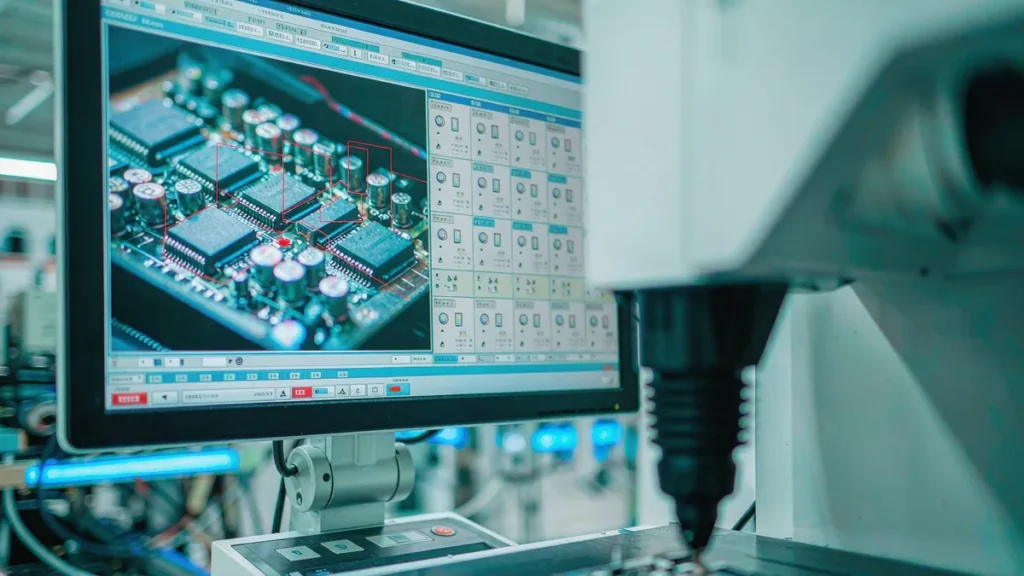
A 2D AOI uses a color or multi-spectral camera with LEDs lighting the board from several angles in sequence. The system judges each component by brightness, color and shape in the X-Y plane: is the part present, is the polarity mark where it should be, does the solder look the right color and size?
This makes 2D fast and affordable — and for many boards genuinely sufficient. Presence, polarity, rotation and gross bridging are reliably detected on components 0603 and larger, on boards without extreme density.
The blind spot is height. A 2D system infers three-dimensional defects from shadows and color gradients, so it struggles exactly where Z matters:
- Tombstoning on small passives — the lifted end may still look “present”
- Lifted leads on ICs and connectors
- Insufficient solder height and weak wetting
- Coplanarity problems on fine-pitch packages
- Dense boards where a color change is a shadow one moment and a defect the next — the root of most false calls
How 3D AOI works
A 3D AOI projects structured light — moiré fringes or laser lines — across the board and captures the deformation with multiple cameras, reconstructing a height map of every pad, lead and component body. From that map it measures what 2D can only guess:
- Solder joint volume and fillet shape, per joint
- Component height, tilt and coplanarity
- Lead lift and true lead geometry on ICs
- Pad coverage measured as a number, not judged by color
Because height is an objective measurement, 3D systems typically deliver both higher first-pass defect coverage and a lower false-call rate. That second effect is easy to underestimate: every false call costs an operator review — and eventually, tired operators start clicking through, and real defects slip past.
What actually matters when you choose
Rather than asking “is 3D better?”, ask these questions about your own production:
| Your situation | leans toward |
| Boards carry 0402/0201, QFN, LGA or fine-pitch packages | 3D — effectively mandatory |
| Automotive, medical or industrial-reliability product | 3D — escape cost beats equipment cost |
| High-density boards, dark or reflective surfaces | 3D — far fewer false calls |
| Mature boards, 0603+ passives, generous land patterns | 2D — excellent value used |
| Operators spending hours clearing false calls | 3D — pays for itself in labor |
| Tight budget, low mix, larger components | 2D — adequate coverage |
Rule of thumb: if your boards carry 0402-or-smaller passives, QFN/LGA or fine-pitch packages — or if they must not fail in the field — choose 3D. For mature boards with larger components, a good 2D system at a used-machine price is excellent value.
Buying a used AOI: checks beyond 2D-vs-3D
The platform matters as much as the dimension. On any used Koh Young, MIRTEC, SAKI, Omron or TRI, check:
- Light source health: LED/laser hours and replacement cost — on some platforms a light engine costs as much as a used machine.
- Cameras and lens: dead pixels, focus consistency across the full travel.
- Calibration plate/target included and valid — without it the machine measures nothing you can trust.
- Software license and dongle: version level, CAD import and offline programming included, not “extra”.
- Library and support: is the platform still supported, and are component libraries available for your mix.
- Golden-board proof: run your own populated board — with known defects if possible — before shipment and review the defect calls together.
The bottom line
2D or 3D is not a grade of good versus better — it is a match between your defect profile and the physics of measurement. Match them honestly, check the platform’s running costs, and a used AOI of either type will guard your line for years. Every used AOI at THOMAO is tested on real populated boards before shipping, with calibration targets, licenses and light-source hours documented in the listing.