
FOB, CIF or DDP? Choosing the Right Term for Used SMT Lines
Logistics · 5 min read
On a used SMT machine, the Incoterm you choose can move thousands of dollars of cost — and all of the risk — between buyer and seller. Yet many first-time importers accept whatever term is quoted without knowing who books the ship, who insures the machine, and at which exact point their money is at risk. Five minutes here can save you a five-figure surprise.
The 60-second refresher
| Term | Books main freight | Insures cargo | Risk passes to buyer | Import clearance & duties |
| FOB | Buyer | Buyer | When goods are loaded on the vessel at the origin port | Buyer |
| CIF | Seller | Seller (minimum cover) | At the origin port, even though freight is paid to destination | Buyer |
| DDP | Seller | Seller | At final delivery to your door | Seller (incl. duties & taxes) |
FOB — maximum control, maximum involvement
Under FOB (Free On Board, named origin port), the seller delivers the machine, cleared for export, onto the vessel you book. From that moment, freight, insurance and every risk belong to you.
FOB is usually the cheapest landed cost — if you know what you are doing. You can shop freight rates among forwarders, consolidate a full line into one container, and choose your own insurance cover. The price of that control is involvement: booking, documentation, destination charges — and demurrage if the container waits at port.
- Choose FOB if: you already have a trusted forwarder and import machinery regularly.
- Watch out for: destination port charges, container demurrage, and the temptation to under-insure.
CIF — the seller ships it, you clear it
Under CIF (Cost, Insurance and Freight, named destination port), the seller books the vessel and pays freight and insurance to your port. You handle import clearance, pay duties and taxes, and arrange the final delivery from port to your factory.
Two details first-time importers miss:
- CIF insurance is the legal minimum (Institute Cargo Clauses C, on ~110% of invoice value) — one of the weakest covers available. For a machine worth tens of thousands of dollars, ask the seller to upgrade to ICC (A) all-risk; the premium is small.
- Risk transfers at the origin port even though freight is paid to destination. If the ship has an accident mid-voyage, the loss is yours — that is exactly what the insurance claim is for. Keep the document set complete so a claim can actually be paid.
CIF is the natural choice for a first-time importer who wants the seller’s shipping experience without giving up control of customs.
DDP — one price, machine at your door
DDP (Delivered Duty Paid) puts everything on the seller: export, freight, insurance, import clearance, duties and final delivery. You receive one invoice and one machine at your gate — the simplest way to buy, and the easiest to budget.
But read the fine print:
- The seller’s price must include the duty. A “DDP” quote that quietly excludes VAT or duties is not DDP.
- In some countries customs require the importer of record to be a local entity — DDP may be impossible there, or may still require you to provide a tax / EORI / VAT number.
- Confirm what “door” includes: unloading? forklift? inside placement? Moving an unpacked two-ton crate is not included by default.
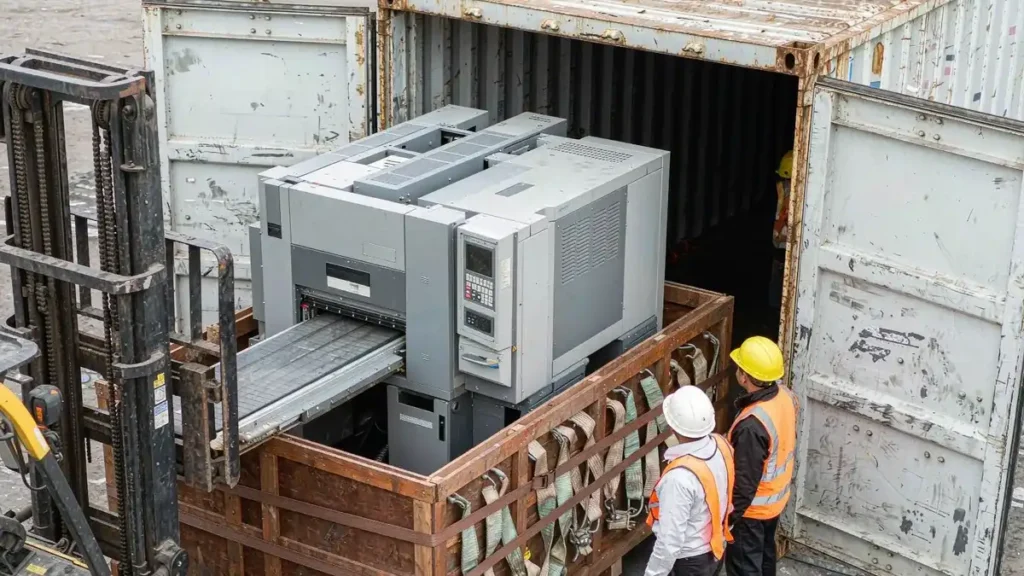
Used SMT machines are heavy, crated and sometimes over-width. A responsible DDP seller plans the forklift, the container type and your site access before quoting — not after the container sails.
Extra rules for used SMT machinery (any term)
- Crating: insist on ISPM-15 stamped wooden cases, machine bolted to the case base, and shock/tilt indicators on high-value units.
- Insurance: insure at full replacement value, all-risk (ICC A). The premium is a small fraction of the machine’s value; a cracked frame is not.
- Documents to receive before the ship sails: commercial invoice, packing list, bill of lading, certificate of origin, serial-number list and (if applicable) CE declaration.
- Time: sea freight to most destinations runs 3–6 weeks. Plan your production schedule and installation resources around it.
How to decide in practice
- First import, no forwarder: choose CIF (to your port — you clear customs with a broker) or DDP (true door delivery).
- Experienced importer with freight rates in hand: choose FOB — you will usually land the machine cheaper.
- In any case: ask for both FOB and CIF quotes and compare total landed cost, not the machine price alone.
The best Incoterm is the one that matches your experience, not the one that sounds cheapest line by line. Tell us your destination port and whether you have a forwarder — THOMAO quotes used SMT equipment FOB Shenzhen, CIF to major ports worldwide, and DDP door delivery, with professional crating, full-value insurance and a complete document set included as standard.