
UKI LX-8 and RS-2: One Line for High-Mix and High-Volume in 2026
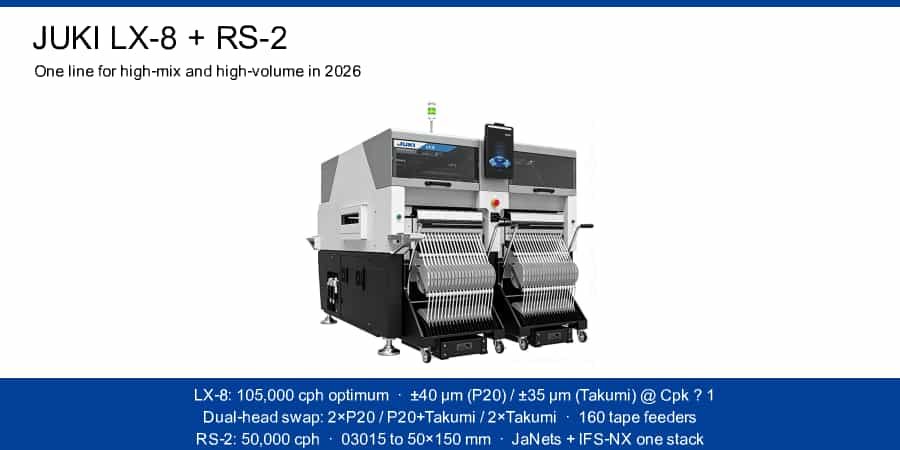
Theme: JUKI — LX-8 Flexible Highspeed Placement Machine (with RS-2 line partner) | Angle: Timeliness | 2026-09-29
The autumn 2026 show calendar is packed — EFX in Stuttgart (October 6–8) and SMTA International in Rosemont (exhibition October 27–29) — and one question keeps surfacing in every meeting room: how do you run true high-mix work and true high-volume work on the same line, without buying two lines and renting twice the floor space?
JUKI’s current answer is a two-machine, one-platform combination: the LX-8 flexible high-speed mounter paired with the RS-2. Both share the same head philosophy, the same feeder ecosystem, and the same software stack, and both are sized for lines where every square meter counts.
One machine, two heads
The LX-8 is unusual in this speed class because it carries two independent placement heads in one 1.6-meter frame — and the operator can swap them without touching the line layout. Three configurations cover very different jobs:
- 2 × P20 planet heads — 105,000 CPH optimum (65,000 CPH IPC9850), for chip-dense boards. Head height switches between 0.5 / 2 / 3 mm.
- P20 + Takumi — 99,500 CPH optimum (63,500 IPC9850), the balanced default.
- 2 × Takumi — 94,000 CPH optimum (62,000 IPC9850), for the widest component and height range.
Accuracy holds at ±0.04 mm with P20 and ±0.035 mm with Takumi, both at Cpk ≥ 1. The component window runs from 0201-metric chips (03015 supported) up to roughly 65 mm square devices — or 10 × 90 mm and 50 × 75 mm formats — with component heights of 25 mm whenever a Takumi head is on board. Boards go from 50 × 50 mm up to 410 × 450 mm in single clamping and about 810 × 450 mm in double clamping.
The TAKUMI head is the quiet hero here. Its laser recognition sensor changes height automatically across six steps (1 / 3 / 6 / 12 / 20 / 25 mm) to match the component being centered, keeping the head as close to the PCB as possible — that is where the tact time comes from. On the feeding side, the LX-8 accepts up to 160 tape feeder stations plus tray handling, which is what lets one machine absorb a genuinely mixed bill of materials.
The RS-2 as the flexible partner
Alongside it, the RS-2 delivers 50,000 CPH optimum (32,000 CPH IPC9850) at ±0.035 mm, handling 03015 components up to 50 × 150 mm (or □74 mm devices) at 25 mm height, with up to 112 feeder spaces and boards to 410 × 370 mm single / 800 × 370 mm double clamping. In a shared line, the RS-2 absorbs the odd-form, tall, and large-component work while the LX-8 holds the volume; both machines stay under 2.5 kVA and fit inside a line shorter than most legacy chip shooters.
Both machines report into JUKI’s JaNets environment with IFS-NX integration — real-time monitoring, predictive alerts, and full traceability across the line, so a mixed LX-8 + RS-2 line is managed as one production unit rather than two islands.
A timely channel move behind the hardware
The timing matters commercially, too. In 2026 JUKI Automation Systems announced a new partnership with Selecs for the DACH market, pairing JUKI’s SMT technology with Selecs’ local consultation and lifecycle support — from the initial investment decision through day-to-day production. For manufacturers in Germany, Austria, and Switzerland evaluating a LX-8/RS-2 line this autumn, that means the engineering conversation now happens much closer to home.
The takeaway
For line planners, the 2026 lesson from JUKI’s lineup is that “high-mix” and “high-volume” no longer force a choice of line. A dual-head LX-8 can re-balance itself by head selection, the RS-2 covers the extremes, and one software stack keeps both honest. As the show season unfolds in Stuttgart and Rosemont, expect this configuration to be one of the most-asked-about line recipes of the quarter.