
Hanwha DECAN S2: The Built-In Skills Behind a 92,000 CPH Line
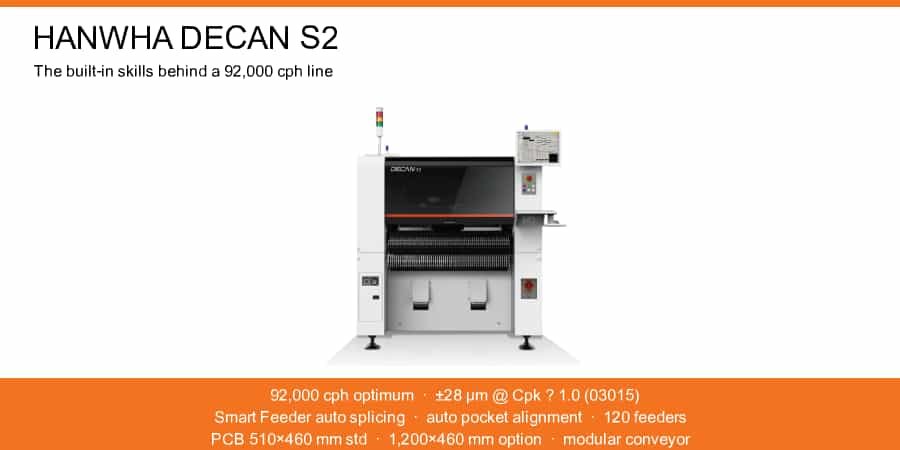
Every high-speed SMT line quietly depends on a handful of veteran skills: splicing tape without losing placement rhythm, teaching feeder pick positions, keeping vision systems honest from head to head. Hanwha’s DECAN S2 is a case study in moving those skills inside the machine — so the line runs like your best engineer never took a day off.
Why this mounter, why now
Hanwha’s SMT business is having a strong run. The company — now called Hanwha Semitech, after the 2026 corporate split that carried the former Hanwha Precision Machinery into the new Hanwha M&S holding structure — reported SMT equipment revenue of roughly KRW 93.6 billion in Q2 2026, up 44.4% quarter-on-quarter and 17.3% year-on-year, returning the division to solid operating profit. The maker of Korea’s first chip mounter back in 1989 is still very much a volume player, and its current-generation DECAN series is a big reason why.
The flagship of that series, the DECAN S2, has also just been refreshed into the DECAN S2 Plus (95,000 cph optimum, a fiber-optic PCB-detect sensor on the guide rails, a quieter vacuum pump, and position teach as standard). But the deeper story — the one worth studying if you run a mixed-technology line — is what the S2 platform already automates.
Four “operator skills” the machine now performs itself
1. Splicing, without the splicer’s touch. Feeder replenishment is where most lines bleed hidden minutes. The DECAN S2’s Smart Feeder system performs automatic feeding and automatic splicing — an industry first when introduced — with zero splicing consumables. The reel swap that once took a steady hand and ten careful minutes becomes a machine routine.
2. Pick-position teaching, done in the background. Instead of an engineer teaching each 8 mm feeder pocket by hand, the machine and feeder communicate to auto-align pocket positions, and pickup coordinates are automatically arranged across feeders. Change the model, and similar part types inherit their pickup information — changeover programming shrinks accordingly.
3. Vision tuning, kept honest at speed. Flying-vision quality drift is a classic source of “mystery” placement defects. On the S2, each head’s LED illumination was reinforced to cut lighting deviation between heads, and coaxial-light ghosting was suppressed to improve recognition rates. For 03015 micro-chips, the field of view was tightened from 24 mm to 20.5 mm — packing more pixels per component — while X/Y resolution improved from 3 µm to 2 µm. The payoff: ±28 µm placement accuracy at Cpk ≥ 1.0 on 03015 chips and ±25 µm on ICs, sustained by automatic calibration routines during production.
4. Changeover, measured in hours not shifts. The modular conveyor can be swapped in the field between shuttle and dual-lane modes in about two hours — no machine return needed. Dual-lane transfer lifts productivity by roughly 15% where the product mix allows it.
The numbers that matter
| Item | DECAN S2 |
| Placement speed | 92,000 cph (optimum) |
| Structure | 2 gantries × 10 spindles, flying vision |
| Accuracy | ±28 µm @ Cpk ≥ 1.0 (03015 chip) / ±25 µm (IC) |
| Component range | 03015 to □12 mm (flying camera); □42 mm standard / □55 mm MFOV (fixed camera) |
| PCB size | 510 × 460 mm standard; up to 1,200 × 460 mm optional |
| Feeder capacity | 120 × 8 mm positions |
| Weight | Approx. 1,800 kg |
What your team should practice instead
When the machine carries the routine skills, the human skills that pay shift up a level: line balancing between chip shooters and odd-form machines, feed-by-data BOM planning so the 120 feeder slots stay strategically loaded, and reading Cpk trends to catch drift before AOI does. The DECAN S2 handles the craft; your engineers get to work on the strategy.
That is the real lesson of the S2 generation — automation is not just about replacing labor, it is about standardizing expertise so every shift runs like your best one.