
Heller Short-Cycle Vacuum Reflow: Faster Cycles Without Giving Up Void Control
*Brand: Heller Industries
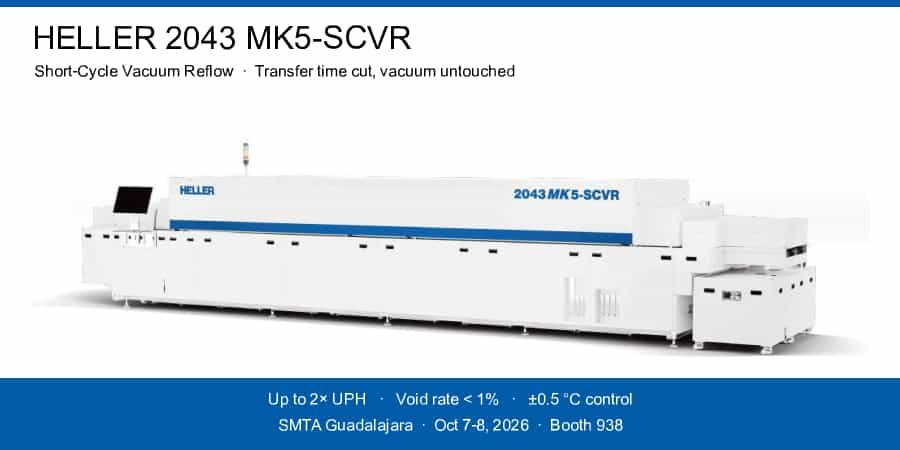
*Product: Short-Cycle Vacuum Reflow (SCVR) oven platform — 2043MK5-SCVR / 2049MK5 SCVR
*Angle: Practicality
*Date: September 23, 2026
—
The trade-off nobody wanted to make
Vacuum reflow earns its place on the line for one reason: it pulls voids out of solder joints. For automotive power modules, RF assemblies and high-reliability boards, that void reduction is the difference between a joint that survives thermal cycling and one that fails in the field.
The problem has always been the bill that comes with it. A vacuum oven’s cycle time is the sum of two things — the time the board spends under vacuum, and the time it takes to move the board into and out of the vacuum chamber. Process engineers who tried to buy back throughput by trimming vacuum time quickly learned the cost: shorten the vacuum, and the void numbers get worse. The vacuum process and the throughput target were fighting each other, and someone had to lose.
Heller Industries is bringing a different answer to the SMTA Guadalajara Expo & Tech Forum, running October 7–8, 2026 at Expo Guadalajara (Salón Jalisco Halls D & E), where the company will exhibit in **booth 938** alongside SEHO Systems GmbH. The focus is Heller’s **Short-Cycle Vacuum Reflow (SCVR)** technology — and the idea behind it is refreshingly practical.
Instead of touching the vacuum process at all, SCVR attacks the other half of the equation: **transfer time**.
Where the time actually goes
Heller’s reasoning is straightforward. If vacuum time is off the table because it drives void performance, then the only remaining lever is the non-value-added time — the seconds a board spends being shuttled in and out of the vacuum chamber.
SCVR addresses that with a **multi-stage, speed-adjustable conveyor system**. The conveyor accelerates board movement before and after the vacuum chamber, while leaving the vacuum process itself untouched. The mechanism is patent-protected (CN222728852U, *A multi-stage speed-adjustable transmission mechanism*), and Heller states the result plainly: this approach can **increase UPH by up to 100%**.
“Manufacturers want the reliability advantages of vacuum reflow, but throughput has traditionally been one of the challenges that must be considered when implementing the process,” said **Paul Lancaster, Vice President of Sales & Marketing at Heller Industries**. “Our Short-Cycle Vacuum Reflow technology was designed specifically around that challenge. Rather than compromising the vacuum process to gain speed, we focused on reducing non-value-added transfer time so customers can achieve both low-void performance and the productivity required for volume manufacturing.”
That framing matters for anyone evaluating the upgrade. This is not a new soldering chemistry or a different alloy strategy. It is a mechanical and control fix aimed squarely at a measured bottleneck — the kind of change a process engineer can justify with a stopwatch and an X-ray machine rather than a leap of faith.
Three IR panels, and a shorter time above liquidus
Transfer time is only half of the practical story. SCVR also puts **three infrared panels inside the vacuum chamber**, heating the board while vacuum is being applied. That lets the solder paste reach its recommended maximum temperature during the vacuum stage rather than before it.
The practical payoff is control over **time above liquidus (TAL)**. Because the board arrives at the vacuum chamber faster and can be heated while inside it, the total TAL window can be tuned to match the solder paste manufacturer’s recommendation instead of being stretched by mechanical handling delays.
Thermal control is handled in real time, with the ability to make granular adjustments to the thermal recipe at **±0.5 °C accuracy**. On the cooling side, the cooling conveyor can be slowed down to extend dwell time in the cooling zone — a useful lever for reducing board exit temperature, which in turn helps cut false calls at post-reflow AOI.
The platform behind it
SCVR sits on Heller’s MK5 vacuum reflow platform. The larger **2049MK5 SCVR** configuration frames the capability clearly:
| Parameter | Specification |
|—|—|
| Heating zones | 12 |
| Cooling zones | 4 |
| Heated tunnel length | 410 cm (490 cm total) |
| Cooling tunnel length | 152 cm |
| Minimum vacuum pressure | 2 mbar (1.5 Torr) |
| Vacuum control | 5-step closed-loop speed / pressure control with dual-stage refill |
| Vacuum pump | 300 m³/hr high-capacity rotary vane pump |
| Temperature range | 60–350 °C (60–450 °C optional) |
| Cross-width uniformity | ±2.0 °C |
| Controller resolution | ±0.1 °C |
| Nitrogen consumption | 150–400 SLPM (9–24 m³/hr) |
| Minimum oxygen | ≤25 ppm |
| Maximum PCB size | 60 cm × 70 cm |
| Conveyor speed range | 1–800 cm/min |
| Footprint | 765 cm × 200 cm |
| Typical weight | 5,200 kg oven / 500 kg pump |
| Power | 22–28 kW oven / 4–7 kW pump @ 480 V |
Several design decisions here read as maintenance arguments rather than marketing ones. The vacuum chamber is a **single-piece CNC-machined aluminum body** with a gas cooling system — a sealing and structural-integrity play, since vacuum performance lives or dies on seal reliability at temperature. An optional **staging conveyor** serves the same fastest-transfer goal as the SCVR mechanism, and **dual-rail conveyors** are available where additional throughput is needed. The conveyor travels smoothly enough that components are not shifted or moved during transit — a detail that matters when you are running large, heavy parts.
Heller has also made the platform upgrade-friendly. The SCVR oven uses a **modular, open architecture** with a reserved MES interface for digital factory integration, and the top shell opens from either the front or the rear to improve access for cleaning and service — a real consideration on ultra-wide tracks, where reaching the middle of the oven has historically been the worst part of preventive maintenance.
What it is actually for
Heller positions SCVR for applications where voids are not negotiable but volume still is:
– High-reliability RF component vacuum soldering
– Mini LED / Micro LED mass reflow
– Highly reliable SMT
– Automotive-grade IGBT / SiC power module packaging
– High-density interconnect soldering
That list is worth reading as a map of where this technology earns its keep. Mini and Micro LED mass reflow and automotive SiC modules both combine large thermal mass with strict void limits — exactly the conditions where the old “vacuum time versus throughput” trade-off used to force a compromise.
The broader collaboration
Heller will co-exhibit with **SEHO Systems GmbH** in booth 938 as part of a wider global collaboration between the two companies. SEHO brings selective soldering, wave soldering, AOI and automation to the table, complementing Heller’s thermal processing and vacuum reflow expertise.
“Our collaboration with SEHO is about giving customers a more complete approach to soldering technology,” Lancaster added. “Manufacturers rarely have only one process challenge. By working together globally, Heller and SEHO can bring complementary expertise to our mutual customers and help them evaluate solutions across a much broader portion of their soldering operation.”
For visitors at Guadalajara, that means one booth covering more of the soldering process than either vendor would alone — and a chance to discuss void reduction, throughput optimization, thermal profiling and high-reliability soldering with both teams in the same conversation.
The practical takeaway
Vacuum reflow’s throughput penalty was never a law of physics. It was a design problem, and SCVR treats it as one.
If your line is running — or considering — vacuum reflow and the business case keeps stalling on cycle time, the question to bring to Guadalajara is a specific one: **how much of my cycle is vacuum time, and how much is transfer time?** SCVR’s entire premise is that the second number is bigger than most people assume, and that it can be engineered down without touching the first. Heller’s claim of up to 100% UPH improvement rests on exactly that distinction.
For process engineers, that is a far easier sell than a new process. Same void performance, same alloy, same profile intent — just less time spent moving the board.
**See it at:** SMTA Guadalajara Expo & Tech Forum, October 7–8, 2026, Expo Guadalajara, Salón Jalisco Halls D & E — Heller Industries and SEHO Systems GmbH, **booth 938**.
—
### Sources
– Heller Industries, “Heller Industries to Showcase Vacuum Reflow Technology at SMTA Guadalajara Expo & Tech Forum 2026” (Global SMT & Packaging, trade show news)