
Ersa VERSAFLOW 4/55 Training: The Skills Behind Reliable Selective Soldering
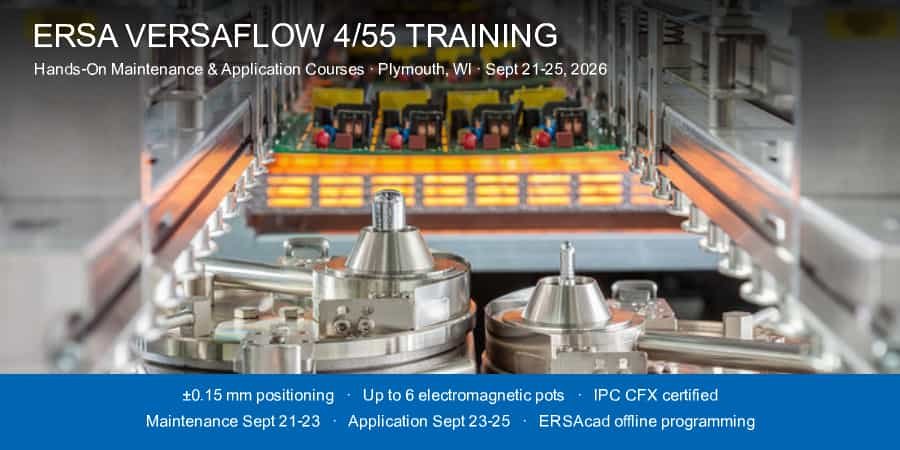
Here is the skill set both courses are built around — worth studying even if you never set foot in Plymouth.
1. Maintenance skills: keep the machine honest
The Maintenance course targets the engineers and technicians who keep the line up. The syllabus reads like a selective soldering health checklist:
- Machine setup and calibration — transport, board support, and axis alignment drift with thermal cycles; recalibration is what keeps a ±0.15 mm positioning accuracy meaningful.
- Nitrogen and pneumatic systems — the VERSAFLOW 4/55 runs at 6 bar with about 1.5 m³/h of N₂ per module; leaks and pressure instability show up first as dross and dull joints, not as alarms.
- Electrical diagnostics — reading schematics and tracing faults instead of swapping boards until the problem “goes away.”
- Preventive maintenance on the three process modules — flux, preheat, and solder. The drop-jet fluxer needs nozzle discipline; the IR/convection preheat modules need cleanliness checks; the electromagnetic solder pots (13 kg mini-wave, up to 6 pots on one machine) need dross management and pot-level verification.
The point of the course is confidence in troubleshooting and routine service — because on an inline selective machine, every unplanned stop blocks the whole back end of the SMT line.
2. Application skills: own the process, not just the program
The Application course is where process engineers spend their two days, and its topics map directly to the defects that show up in rework:
- Process parameter setup and temperature profiling. Selective soldering lives or dies on preheat. A PCB that arrives at the wave too cold wicks heat out of the joint and freezes the solder mid-capillary; a board that’s too hot suffers thermal shock and lifts pads. Homogeneous, gentle preheating — IR bottom heat with convection top heat — is the foundation, and Ersa’s own success stories describe adding extra preheat modules just to keep long-lead-time boards warm enough.
- Lead-free solder practice. SAC alloys leave less working margin, so wave height (5 mm nominal), contact time, and pot temperature (up to 330 °C on this platform) have to be set deliberately, not copied from the last job.
- Flux selection and drop-jet accuracy. With ±0.15 mm flux positioning, the skill is matching flux volume and spot pattern to the connector — too little gives incomplete wetting, too much forces cleaning and risks reliability issues.
- Throughput optimization. On the dual-pot VERSAFLEX configuration, the two pots can run synchronously or asynchronously on independent axes, so panels with different nozzle demands still finish together — the difference between a theoretical and an actual takt time.
3. Programming skills: ERSAcad and the CAD Assistant
One theme from the training catalog deserves its own mention: offline programming. With ERSAcad, engineers build and modify soldering programs at a PC without interrupting production. On the machine, the integrated CAD Assistant 4 imports board data, and its auto-routing function generates efficient process paths while exclusion zones prevent pot-to-board collisions. For high-mix floors, this is the skill that turns “programming a new board” from an hour of machine downtime into a coffee break.