
MIRTEC MV-6TB: One Pass, Two Sides — Rewriting AOI Throughput
**Angle: Innovation**
For twenty years, AOI has been a one-sided conversation. The board goes through, the top gets inspected, and if the assembly is double-sided, it goes through again — or a second machine does. Either way, the line pays twice: twice the cycle time, twice the floor space, twice the handling risk on a board that has already been through reflow.
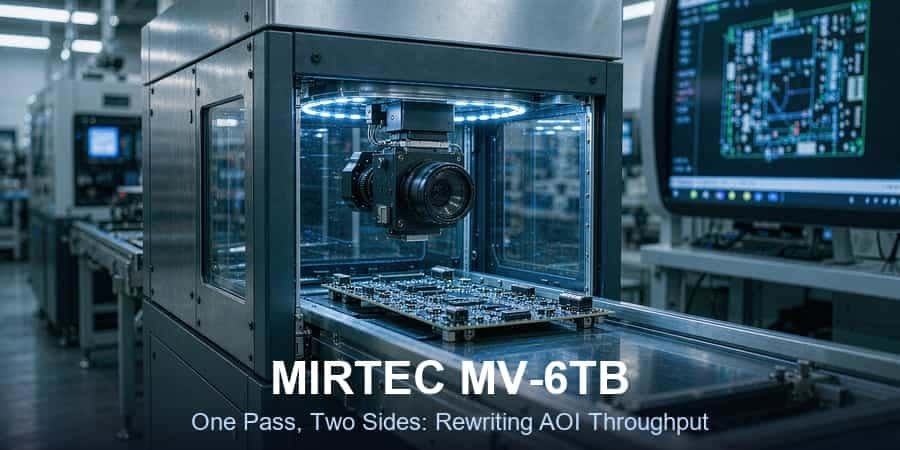
MIRTEC’s MV-6TB questions that assumption. It is a 3D/2D AOI platform built specifically for simultaneous top-and-bottom PCB inspection in a single pass. MIRTEC will bring it to SMTA Guadalajara 2026 (October 7–8, Expo Guadalajara, Booth 302) alongside its wider 3D AOI, SPI and smart-factory portfolio — and the reason it belongs in the “innovation” column rather than the “spec bump” column is architectural, not optical.
The core idea: inspection stops being a sequence
Conventional dual-side inspection is a sequence of two events. You inspect side A, then you inspect side B. Even when both happen inside one platform, they happen in series, and the total tact time is the sum of both.
The MV-6TB removes the sequence. Both sides of the PCB are imaged and evaluated within one pass of the conveyor. Nothing is staged, nothing is re-handled, and the board leaves the machine with a full two-sided verdict.
That single design decision cascades through the whole line. Cycle time drops because you are no longer adding a second inspection event. Line layout simplifies because you are no longer planning for two inspection stations or an inverter-based second pass. And floor space — always the scarcest resource on a mature SMT floor — gets handed back to production.
Where the architecture has to carry its weight
A one-pass dual-side claim is easy to make and hard to deliver, because you have just doubled the imaging work per board without adding time. MIRTEC’s answer is the **Dual PC Architecture**: separate computing paths handle the top and bottom inspection streams independently, processing the two data sets in parallel rather than queueing them through a single pipeline.
That is the part worth paying attention to. The bottleneck in 3D AOI has never really been the camera — it is the reconstruction. Point clouds, height maps, warpage models and defect classification all consume compute, and a single processing chain that has to digest both sides of a board will either slow down or start making compromises on resolution. Running the two sides on independent, parallel compute paths is what allows MIRTEC to claim both high-speed inspection and high-accuracy detection at the same time, and it is the mechanism behind the headline productivity improvement of up to 200%.
In practice, “up to 200%” should be read the way you should read any vendor figure — as the ceiling, not the average. The realistic gain depends on your board mix, inspection recipe complexity and defect density. But the structural point stands: eliminating a serial inspection event is one of the few throughput levers left on a line that has already been optimised to death.
Flexibility, and the parts that used to be awkward
The MV-6TB is not a single-purpose double-sided machine. It is configurable across SMT, THT and PBA processes, so the same platform can serve different inspection stages without a different machine type.
Two options are worth flagging for anyone running dense or mixed-technology assemblies:
– **Z-axis optics with GPU acceleration (optional)** — extends the height range for tall parts to 70 mm, well beyond the 25 mm ceiling that constrains most conventional 3D AOI systems. That opens up assemblies with large electrolytics, connectors, transformers and other tall through-hole parts that normally force a separate inspection strategy or a manual check.
– **18 MP side cameras (optional), four of them** — bring side-view inspection into play for solder joints and markings that a top-down view simply cannot resolve. That means OCR from the side, plus solder evaluation on J-leads, coils and QFNs — exactly the geometries that generate the false calls and escapes that quality teams spend their evenings chasing.
Combined, those options push the MV-6TB beyond the “double-sided version of a standard AOI” framing. It becomes a platform that handles the assemblies most likely to break a conventional inspection plan.
Why this matters for the wider line
The more interesting signal here is not the machine itself but what it says about where inspection is heading. As boards get denser, more double-sided, and more heavily populated with tall and mixed-technology parts, the cost of inspecting them in sequence keeps climbing. At some point, the inspection step stops being a quality gate and becomes the constraint on the line.
MIRTEC’s answer is to attack the sequence itself rather than to make each step marginally faster. For high-volume, double-sided production — server boards, automotive control units, power electronics — that is the right place to push.
The MV-6TB will be on show at **SMTA Guadalajara 2026, Booth 302** (October 7–8, Expo Guadalajara, Mexico), and at **SEMICON West 2026, Booth 6162**. For a line that is already fighting for tact time and floor space, it is worth a look — not because it inspects better, but because it stops asking you to inspect twice.
—
*Sources: MIRTEC press announcement (September 2026); MIRTEC MV-6TB official product page; US Tech Online coverage of SMTA Guadalajara 2026.*