
Yamaha YRi-V AOI: Putting AI Where Inspection Programming Hurts Most
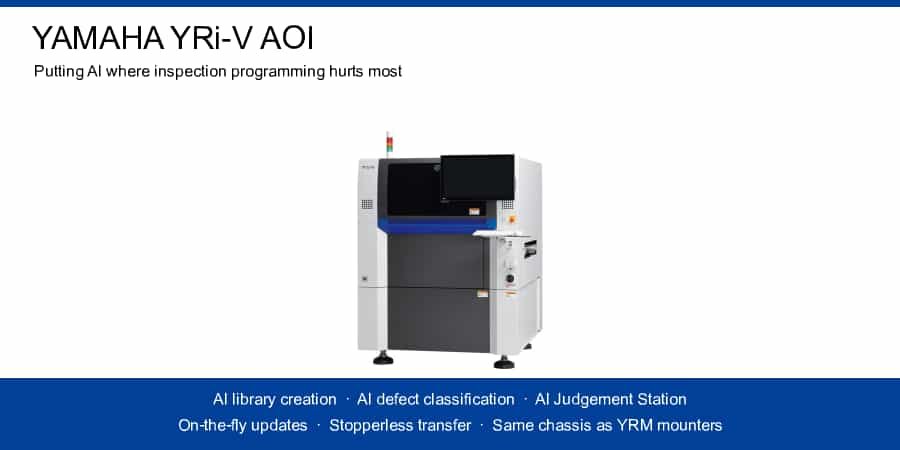
Skill focus — how working engineers can actually bank the hours these new features promise
c
Every SMT process engineer knows where the real time goes in AOI: not the inspection itself, but everything around it. Building the component library, teaching a new board program, classifying the same false calls for the thousandth time, and triaging the repair queue. Yamaha Robotics used its EFX 2026 preview (Stuttgart, October 6–8, Booth 9B50, Hall 9) to announce a wave of AI-driven features for the YRi-V AOI platform that attack exactly these pain points. Here is a practical breakdown of what each one does, and how to sequence them so the gains actually land on your line.
Start with the library, because everything else waits on it
Component-library creation is the first bottleneck of any NPI, and it is where Yamaha’s AI tools for the YRi-V are aimed first. Instead of hand-building recognition data for every new part number, the AI-assisted workflow prioritizes the laborious setup tasks: library creation, programming, and defect classification. The practical implication for engineers is that the days of treating library work as a separate, offline job are numbered — fold it into the NPI checklist as an automated step, and the schedule you quote for first-article inspection gets shorter and more honest.
Let the machine classify before your operators do
Defect classification is the second time sink, and it compounds: every new product imports the false-call habits of the last one. Yamaha’s AI classification tools on the YRi-V are designed to take over the bulk of that triage, which does two things for a working line — it stabilizes escape risk by applying criteria consistently across shifts, and it frees your most experienced inspector for genuine process debugging instead of clicking “OK” on solder-shade variations. The skill here is calibration discipline: audit the AI’s verdicts for the first few NPI runs, feed corrections back, and only then relax the manual review.
Triage repair and rework with the AI Judgement Station
New to the platform is the AI Judgement Station, which triages defects into repair versus rework pathways. That distinction matters more than most lines admit — sending a lifted lead to the wrong queue wastes both an operator trip and a cycle. Making the machine do the first-pass sorting turns the review station into a confirmation step rather than a decision step.
Three workflow features that remove hidden board-handling time
Alongside the AI headline acts, Yamaha added quieter features that skillful line owners should not overlook:
– **On-the-fly program update** — refine the inspection program while production continues, instead of pausing the line for a program revision.
– **Stopperless board transfer** — boards flow through without hard stops, shaving cycle time on high-volume panels.
– **Automatic alignment checking for arrayed components** — array packages get verified for alignment without a separate manual check, closing a classic escape route.
Why the chassis matters: shared hardware with the YRM mounters
The YRi-V rides on the same chassis platform that anchors Yamaha’s YRM mounters (the YRM20 places up to 115,000 cph, or 120,000 cph in dual-lane). For inspection, that mechanical rigidity translates into high-quality image capture at fast scan speeds — confident judgements with high board coverage and fast cycle time. If you already run YRM mounters, adding a YRi-V extends a familiar hardware and support ecosystem; the AI tools then ride on top of cleaner, more stable image data than a lighter-duty AOI can deliver.
A sensible adoption order
1. Deploy AI library creation and programming first — it unlocks every subsequent NPI.
2. Turn on AI defect classification, audit it through two or three NPI cycles, then trim manual review.
3. Add the AI Judgement Station once classification data is trustworthy.
4. Switch on on-the-fly program updates and stopperless transfer when the line is stable — these are throughput features, not quality features.
The pattern across all of it is consistent: Yamaha is moving the AOI engineer’s job from data entry to judgement. The shops that benefit fastest will be the ones that treat these AI tools as trainable colleagues — audited early, corrected consistently, and trusted progressively.
—
*Source: Yamaha Robotics EFX 2026 exhibition preview (EFX, Stuttgart, October 6–8, 2026, Booth 9B50, Hall 9), as reported by EPP Europe, August 2026.*