
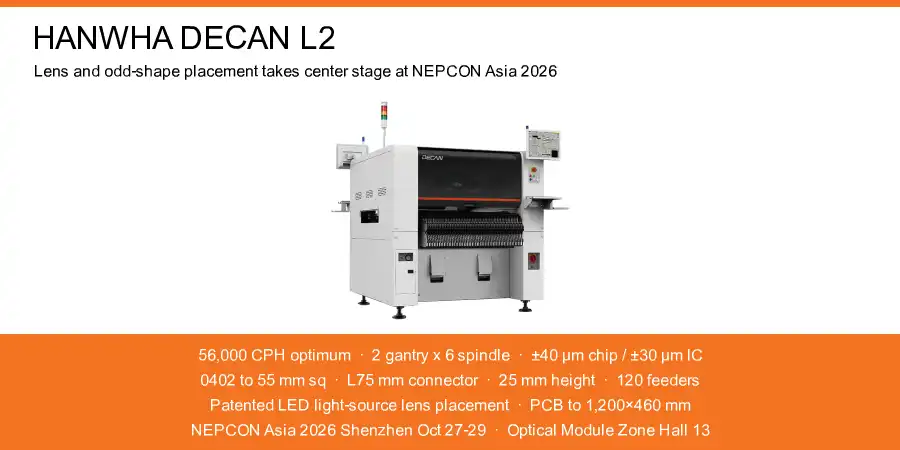
Hanwha DECAN L2: Lens and Odd-Shape Placement Takes Center Stage at NEPCON Asia 2026
2026-10-11 · Angle: Timeliness (Market Watch)
NEPCON Asia 2026 opens on October 27–29 at the Shenzhen World Exhibition & Convention Center (Bao’an), and this year’s edition is unusually easy to read.
The organizer’s own figures set the stage: roughly 100,000 sqm of show area, more than 600 exhibitors, 77,000+ expected professional visitors and 3,000+ overseas buyers — with the co-located shows pushing the combined platform past 170,000 sqm and 3,600 brands. Industry previews list Hanwha among the headline equipment exhibitors, next to Panasonic, Fuji, Yamaha, Omron, Kurtz Ersa and Nordson.
The part placement engineers should circle, though, is new for 2026: an Optical Module Manufacturing Process Demo Zone in Hall 13, built around COB packaging, module assembly, and test-and-burn-in for 800G, 1.6T and 3.2T products.
That zone is a signal. The placement bottleneck in high-growth electronics is no longer raw chip-shooter speed. It is the odd, the long, and the optically aligned — which is exactly where the Hanwha DECAN L2 lives.
Why odd-shape placement is suddenly the headline
Three pressures converge this quarter:
- AI hardware keeps adding large connectors, power modules, shields and housings that no chip head can pick.
- Optical modules have moved 800G into mass deployment and 1.6T into volume production, with 3.2T development accelerating. Module assembly means seating lenses and optical sub-elements precisely against a light path.
- LED lighting and backlight bars remain the classic long-board, lens-on-LED problem.
All three land on the same class of machine: a multi-functional placer that can place a 0402 in the morning and a 75 mm connector or a lens in the afternoon.
The DECAN L2 in one table
Hanwha’s DECAN family splits cleanly into three (figures from Hanwha Semitech’s official specification page):
| |||
Head | 10 spindle × 2 gantry | 10 spindle × 2 gantry | 6 spindle × 2 gantry |
Speed (optimum) | 92,000 CPH | 80,000 CPH | 56,000 CPH |
Chip accuracy | ±28 µm @ Cpk ≥ 1.0 (03015) | ±40 µm @ Cpk ≥ 1.0 | ±40 µm @ Cpk ≥ 1.0 |
IC accuracy | ±30 µm @ Cpk ≥ 1.0 | ±30 µm @ Cpk ≥ 1.0 | ±30 µm @ Cpk ≥ 1.0 (stage vision) |
Fly-camera range | 03015 – □12 mm | 0402 – □16 mm | 0402 – □21 mm |
Fix-camera range | □42 mm std / □55 mm (MFOV) / L75 | □42 mm std / □55 mm (MFOV) / L75 | □42 mm std / □55 mm (MFOV) / L75 |
Max component height | 10 mm fly / 15 mm fix | 12 mm fly / 25 mm fix | 12 mm fly / 25 mm fix |
The L2 gives up 36,000 CPH against its fastest sibling to gain the tallest and widest odd-form window in the family — 25 mm component height and the MFOV connector option — plus the LED and lens toolset the S2 and F2 do not emphasize.
The lens trick, and why it travels
The L2 recognizes the LED’s light source and then places the lens relative to that source rather than to the package outline alone (patented). It also reads LED direction, model variation and lens protrusion, and pairs a 3D lighting system with a strengthened vision algorithm for odd-form recognition.
Read that as a process skill, not a spec. Wherever a small optical element must sit over an emitting or receiving element — LED bars today, optical-module sub-assemblies tomorrow — the required competence is the same: sense the optical datum, then place against it.
The rest of the machine supports that discipline on a real line:
- Bad-mark sharing between machines cuts cycle time instead of re-recognizing marks at every station.
- Optimized fiducial path for the individual marks on LED bars.
- On-site conversion to large-PCB handling — up to 1,200 × 460 mm, with options to 1,500 × 460 mm.
- Conveyor flexibility — 1-2-1 standard, with 1-2-2, 2-2-2, 2-2-1 and 1-1-1 layouts plus dual-lane transfer.
- 120 × 8 mm feeder positions (112 with docking cart), max 5.0 kVA, approx. 1,800 kg.
If you are buying — new or used — check these six
- Head configuration: 2 gantry × 6 spindle, and which head options fit your component mix.
- MFOV fitted? Without it you lose the □55 mm and L75 mm connector window.
- Stage vision present for ±30 µm IC placement, or fly vision only?
- Conveyor layout actually installed — 1-2-1 versus 2-2-2 changes your line plan more than CPH does.
- Large-PCB conversion — was it done at the factory, and is the frame and conveyor set for 1,200 × 460 mm?
- LED/lens recognition software licensed and demonstrable — ask for a lens-placement video on your own board.
The window is now
Hanwha Semitech walks into this show under a new corporate roof — Hanwha M&S, the holding company launched on August 3, 2026 — and with SMT revenue up 44.4% quarter-on-quarter in Q2 2026. Demand is not waiting for anyone.
NEPCON Asia 2026, Hall 13, October 27–29, Shenzhen. If your roadmap includes optical modules, AI hardware or long LED assemblies, spend your hall time on odd-shape and lens placement — the machines that do it well are the ones your 2027 yield will remember.