
Heller Vacuum Reflow: The Skills Behind Sub-1% Solder Joints
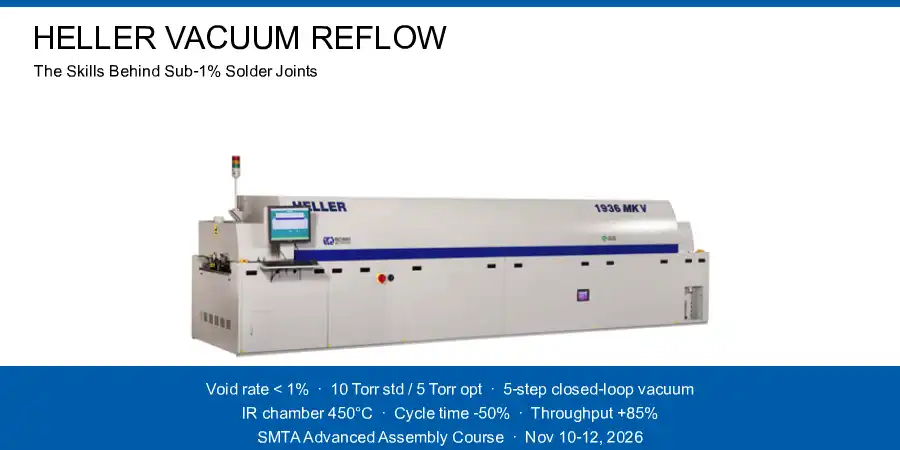
Creation angle: Skills — what the machine automates, and what the engineer still has to know.
When SMTA announced its new Advanced Electronics Assembly Technologies course (November 10–12, 2026, live online, taught by industry veteran Keith Bryant), one line in Module 2 stood out: void reduction, and vacuum, nitrogen and formic acid reflow. Void control has quietly grown from a power-electronics niche into a certifiable core skill — and Heller’s vacuum reflow platform is the clearest example of how much of that skill now lives inside the machine, and how much still belongs to the engineer.
Skill 1: Understanding why voids form
Flux and moisture outgas during reflow, leaving bubbles trapped in the molten joint. Heller’s own application literature classifies the void family — macro (process) voids, shrinkage voids, IMC voids, design-induced voids — and points out that macro voids, driven by paste, PCB, component or process factors, are the ones engineers fight daily. Under reduced pressure those bubbles grow, coalesce, gain buoyancy, and finally escape at the joint edge. If you understand that mechanism, every vacuum recipe decision that follows becomes logical rather than superstition.
Skill 2: Writing a vacuum recipe that doesn’t splash
Heller’s vacuum chamber sits in the reflow zone and supports up to 5 separate pump-down steps with closed-loop pump and pressure control. That closed loop is the difference between a recipe and an experiment: pump down too aggressively and you get solder splash and solder balls; too gently and the voids survive. Heller pairs this with ultra-smooth transport (Z-axis vibration held near ±1 G through the chamber) so fast-moving boards don’t shift components while the solder is liquid. The payoff: void rates below 1% for many applications, with zero solder splatter.
Skill 3: Keeping the peak inside the chamber
A classic vacuum-reflow mistake is letting the board cool before the vacuum even starts. Heller’s 3-zone IR heating inside the vacuum chamber (up to 450 °C, 480 °C optional) holds or raises product temperature during the pump-down, so the peak occurs inside the chamber and time above liquidus stays short. Around it, the convection sections run at ±0.1 °C controller resolution with cross-width uniformity around ±2 °C — the numbers that keep a vacuum result repeatable across a full charge of mixed-size boards.
Skill 4: Making void-free fast
The old objection was that vacuum means slow. Heller’s high-UPH multi-stage conveyor system uses 5 independently controlled conveyors with staging sections that shuttle boards in and out of the chamber, cutting cycle times by up to 50% and lifting typical throughput by 85% or more; a dual-lane board aligner fills the chamber two boards at a time. A separate cooling conveyor can even be slowed down to lower board exit temperatures. Void-free and high-UPH are no longer a trade-off — but only if the line engineer knows how to balance staging, lane pairing and profile changeover (5–15 minutes on the 1936 MK5-VR class machines).
Skill 5: The frontier — going fluxless
For IGBT, ball-attach and flip-chip work, Heller’s VFAR combines vacuum with formic acid reflow: oxides are removed before melting, flux — and every flux-related defect — disappears from the process. A patented formic gate system (double doors that never open simultaneously) cuts process gas consumption by up to 45%, and published IGBT void results land between 0.2% and 0.7%.
Practice before November 10
You don’t need the course to start. Pull last quarter’s X-ray data and calculate void area percentages per joint, map them against profiles and pump settings, and document your current vacuum recipe as if someone else had to run it. And if a used Heller vacuum reflow oven is on your shopping list, the checklist writes itself: vacuum pump hours and service history, chamber door seal condition, IR heater elements, the 5-step control software license, and refill-valve function.
Sub-1% is not a machine number or a people number. It is both — and now it is a credential too.