FUJI CLT-FG: A One-Meter Mounter Built for High-Mix SMT
September 18, 2026
Date: September 18, 2026 Brand: FUJI CORPORATION | Product: CLT-FG Compact All-in-One Placement Machine Angle: Innovation — flexibility without the footprint
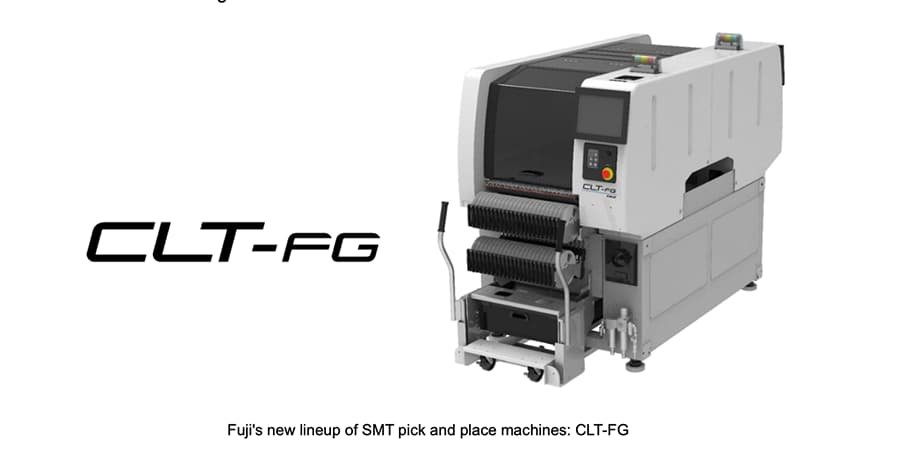
SMT equipment announcements usually chase the same three numbers: faster, wider, heavier. FUJI just went the other way. The CLT-FG, first unveiled at JISSO PROTEC 2026 and now being presented on the European show circuit by FUJI EUROPE (EFX, Hall 9, Stand A72), is a placement machine roughly one meter wide — and that constraint is the whole point. The Innovation: Flexibility Without the Footprint The CLT-FG is built on a “Compact All-in-One Machine” concept. Instead of splitting a product mix across dedicated high-speed chip shooters and odd-form machines, it runs a universal placement head that covers the full range: high-speed placement of small chip components on one end, stable handling of large parts on the other. For a high-mix, low-volume factory, that changes the economics of the line: One machine, many products. Frequent changeovers happen on a single platform instead of requiring rebalancing across specialized machines. One meter of floor space. Space-limited facilities — urban plants, lab-scale lines, expansion into corners of an existing building — can now host a full-capability mounter. Proven platform underneath. Fuji has been explicit that the CLT-FG inherits its long-established placement technologies and existing platform assets, including compatibility with current equipment, so it slots into a line instead of replacing one. The compact body is not a stripped-down entry machine; it is the same core capability, re-packaged around the reality that most modern factories are not running one product at massive volume anymore. It Is One Piece of a Bigger Play: Target Zero What makes the CLT-FG genuinely interesting is the strategy it belongs to. Fuji’s Target Zero framework sets four goals — Zero Placement Limits, Zero Machine Operators, Zero Placement Defects, and Zero Machine Stops — and each one attacks a different traditional boundary: Zero Placement Limits is Fuji pushing both ends of component handling: its NXTR platform already processes 016008 mm components (0.16 × 0.08 mm — barely visible to the naked eye), while an NXTR-S module with a dedicated nozzle handles a 200 × 200 mm component weighing up to 2 kg. Zero Machine Operators moves automation upstream of the machine itself. The Auto Kitting Station automates loading component reels into feeders — a kitting and setup process that has stubbornly remained manual in most plants. Combined with the Smart Storage Unit, the NEXIM production system, and autonomous mobile robots, material flows continuously from warehouse to line with minimal hands-on work. Zero Placement Defects leans on process data and assistant tools such as the Printing Navigator, which helps engineers converge on stable print parameters faster during new product introduction. As Sascha Frieling, Manager Technology at FUJI EUROPE CORPORATION, put it: “The demands placed on SMT manufacturing are evolving in almost opposite directions. That is why we believe it is crucial not to create a new standalone solution for every new requirement. Target Zero represents a platform approach that allows manufacturers to continuously develop their production environment as products and production conditions change.” Why It Matters on the Floor If you run high-mix production, the CLT-FG addresses the three costs that quietly dominate your P&L: changeover time, floor space, and operator dependency. A one-meter machine with a universal head shortens changeovers, the Auto Kitting Station removes the most labor-hungry step in material preparation, and NEXIM ties planning, setup management, monitoring, and traceability together so the process stays repeatable as products rotate. The Bottom Line: the industry has spent years proving a mounter can be bigger and faster. FUJI’s bet with the CLT-FG is that the next frontier is a machine that is smaller, more flexible, and needs fewer people around it — and for a lot of factories, that bet lands closer to home than another 100,000 CPH headline number.